Reservation in the UPSC Civil Services Exam is where seats are reserved in proportion to the total number of seats available for candidates belonging to Scheduled Castes, Scheduled Tribes, Other Backward Classes, Economically Weaker Sections, and Persons with Benchmark Disabilities.
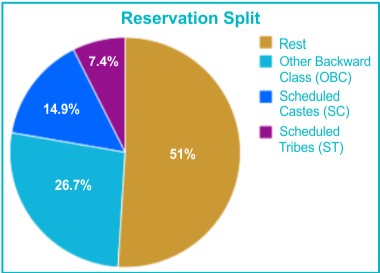
In the SCs, 15 percent of seats are reserved, STs 7.5 percent, OBC (non-creamy layer) 27 percent, and EWS 10 percent.
For persons with benchmark disabilities, a 4 percent horizontal reservation is also made in all other categories of seats.
UPSC Reservation Percentage: SC, ST, OBC, EWS, and PwBD
These figures apply to the Civil Services Examination as a whole and are revised only through a fresh government order, not every year.
| Category | Reservation |
|---|---|
| Scheduled Castes (SC) | 15% |
| Scheduled Tribes (ST) | 7.5% |
| Other Backward Classes (OBC, non-creamy layer) | 27% |
| Economically Weaker Sections (EWS) | 10% |
| Persons with Benchmark Disabilities (PwBD) | 4% (horizontal) |
The reservation for PwBD is quite different from the other three. This is because it follows the horizontal system.
That is to say, before competing against other candidates, a PwBD candidate competes with their fellow PwBD candidates of General, OBC, SC, ST, and EWS categories.
Reservation in UPSC
Reservation in the UPSC Civil Services Exam means reservation on a quota basis for vertical and horizontal allocation for Reservation in UPSC for SC/ST/OBC/EWS categories.
Quota system includes Schedule Castes (SC) 15 %, Schedule Tribes (ST) 7.5 %, Other Backward Classes (OBC) 27 %, Economically Weaker Section (EWS) 10 %, and Persons with Benchmark Disabilities (PwBD) 4%.
OBC Reservation in UPSC
OBC reservation for UPSC exams is applicable only for those who belong to the non-creamy layer category.
Because the threshold of the creamy layer depends upon the income, candidates need to check the DoPT notification every time.
The caste should come from the Central OBC list rather than from the state list. The OBC certificate must also be valid because UPSC can reject an expired OBC certificate.
EWS Reservation in UPSC
The EWS Reservation was made operational through the 103rd Constitutional Amendment Act of 2019 and applies to General Category students who are not eligible for reservation under SC, ST, and OBC categories.
- Income of the family for the previous financial year before applying should not exceed ₹8 lakhs per annum.
- The family should not possess five acres or more of agricultural land.
- The flat in which they reside should be less than 1,000 square feet, while the residential plot should not exceed 100 sq. yards within a notified municipality and 200 sq. yards outside a notified municipality.
Unlike OBC reservation, EWS candidates do not get any relaxation in age and also not any attempt. They only get a seat reservation.
PwBD Reservation
Reservation for PwBD is meant for persons having benchmark disability of 40 percent or more certified by a medical board constituted under the Rights of Persons with Disabilities Act, 2016.
The 4% PwBD quota is sub-allocated across five benchmark disability categories specified under the RPwD Act, 2016.
The facility of scribe, extended exam time, and accessible exam centers is available to PwBD. The scribe’s qualification cannot exceed the standard of the examination being conducted.
Reservation for Women, Ex-Servicemen and PwBD
In UPSC reservation, there are two parallel tracks. SC, ST, OBC and EWS are vertical categories, with a specific quota allocated to each of them.
PwBD and ex-servicemen belong to horizontal categories which apply to all these vertical categories; hence, a PwBD belonging to an OBC category can benefit from both the OBC quota and PwBD sub-quota.
No separate quota for women exists in the Civil Services Examination; however, individual services and state cadres have their own quota for women after the candidate has been allotted a service.
Unlike PwBD, Ex-Servicemen do not get a seat reservation quota in the UPSC Civil Services Examination (Group ‘A’ services); they are granted age relaxation (5 years) to compete across vertical categories.
Age Relaxation and Number of Attempts by Category
Age and attempts shall be counted up to 1 August in the examination year, but not necessarily at the same time.
A General entrant who starts at 21 and takes examinations every year will exhaust all six attempts by the age of 26, long before the age limit of 32 is reached.
| Category | Upper Age Limit | Age Relaxation | Number of Attempts |
|---|---|---|---|
| General / EWS | 32 years | None | 6 |
| OBC (non-creamy layer) | 35 years | 3 years | 9 |
| SC / ST | 37 years | 5 years | Unlimited (within age limit) |
| PwBD (General/EWS/OBC) | 42 years | 10 years | 9 |
| PwBD (SC/ST) | 47 years | 15 years | Unlimited (within age limit) |
| Ex-servicemen | 37 years (General/EWS) | 5 years | Depends on category (General: 6, OBC: 9, SC/ST: Unlimited) |
Candidates belonging to reserved categories can combine their community relaxation with special category relaxations. For example, an OBC Ex-serviceman gets a cumulative age relaxation of 8 years (3 years for OBC + 5 years for Ex-serviceman), extending their upper age limit to 40 years.
How to Apply For UPSC Reservation?
To apply for UPSC reservation:
- Select your category (SC/ST/OBC/EWS/PwBD) in the online application form; there’s no separate reservation form.
- Keep certificates ready in advance: OBC Non-Creamy Layer certificate, EWS Income & Asset Certificate, or PwBD disability certificate (40%+, from a government medical board).
- Caste must be on the central OBC/SC/ST list, not just a state list.
- All reservation certificates (EWS, OBC, SC/ST, PwBD) must be issued before the Prelims application closing date and are physically verified against originals during the Personality Test.
- Category can’t be changed later, so get it right at registration
Documents Required to Claim Reservation
To claim a UPSC reservation, there are some required documents:
- Caste Certificate from the Central List issued by the Competent Authority for claims relating to SC, ST or OBC.
- Certificate of being OBC Non-Creamy Layer, which must be valid and not beyond the prescribed period for that year, as defined by UPSC for the concerned year.
- Income and Asset Certificate for claims of EWS, according to the prescribed form of the Government.
- Disability Certificate issued by the Government Medical Board for claims of PwBD, along with UDID Card wherever applicable.
Certifications submitted beyond the prescribed cut-off date are normally not accepted, regardless of actual eligibility.
Conclusion
Reservation for UPSC has been classified into five categories, with different eligibility criteria and different seat allocations for each category. But all the candidates have to go through the same three stages of examination.
The Central list of Other Backward Classes (OBCs) is the only applicable list for UPSC, not the state list.
The candidates must also keep their certificates and documents up to date before appearing for the exam.
FAQs
59.5% is the aggregate vertical reservation for UPSC civil services examinations, and it consists of reservations of seats for the following categories:
Other Backward Class, Scheduled Caste, Scheduled Tribe, and Economically Weaker Section. Additionally, there is a horizontal reservation of 4% for Persons with Benchmark Disabilities (PwBD).
There is no reservation in the UPSC Civil Services Examination for women. There can be reservations only in respect of social groups like SCs, STs, OBCs, and EWS in the UPSC.
Reservation means reservation in respect of categories mentioned above and not for gender.
CA, CS, and CMA are examinations; there is no provision for reservation quota in professional certification.
General unreserved candidates failing to satisfy income or asset thresholds for EWS and OBC candidates falling within the “creamy layer” category.
People with disabilities lower than 40 percent for the PwBD category, and those unable to furnish their caste or category certificates