The UPSC gives its aspirants 48 subjects out of which the aspirant has to select just one optional subject out of this total of 48 subjects. These 48 subjects have been divided into 25 core subjects and 23 literary subjects.
The popularity level of these 48 subjects differs a lot. Political Science and Sociology & Anthropology are popular subjects, whereas Bodo Literature is not.
UPSC Optional Subject List
The table below lists every optional subject the UPSC allows, grouped by core disciplines and language literature options.
| No. | Optional Subject | Category |
|---|---|---|
| 1 | Agriculture | Core Subject |
| 2 | Animal Husbandry and Veterinary Science | Core Subject |
| 3 | Anthropology | Core Subject |
| 4 | Botany | Core Subject |
| 5 | Chemistry | Core Subject |
| 6 | Civil Engineering | Core Subject |
| 7 | Commerce and Accountancy | Core Subject |
| 8 | Economics | Core Subject |
| 9 | Electrical Engineering | Core Subject |
| 10 | Geography | Core Subject |
| 11 | Geology | Core Subject |
| 12 | History | Core Subject |
| 13 | Law | Core Subject |
| 14 | Management | Core Subject |
| 15 | Mathematics | Core Subject |
| 16 | Mechanical Engineering | Core Subject |
| 17 | Medical Science | Core Subject |
| 18 | Philosophy | Core Subject |
| 19 | Physics | Core Subject |
| 20 | Political Science and International Relations | Core Subject |
| 21 | Psychology | Core Subject |
| 22 | Public Administration | Core Subject |
| 23 | Sociology | Core Subject |
| 24 | Statistics | Core Subject |
| 25 | Zoology | Core Subject |
| 26 | Assamese Literature | Literature Subject |
| 27 | Bengali Literature | Literature Subject |
| 28 | Bodo Literature | Literature Subject |
| 29 | Dogri Literature | Literature Subject |
| 30 | Gujarati Literature | Literature Subject |
| 31 | Hindi Literature | Literature Subject |
| 32 | Kannada Literature | Literature Subject |
| 33 | Kashmiri Literature | Literature Subject |
| 34 | Konkani Literature | Literature Subject |
| 35 | Maithili Literature | Literature Subject |
| 36 | Malayalam Literature | Literature Subject |
| 37 | Manipuri Literature | Literature Subject |
| 38 | Marathi Literature | Literature Subject |
| 39 | Nepali Literature | Literature Subject |
| 40 | Odia Literature | Literature Subject |
| 41 | Punjabi Literature | Literature Subject |
| 42 | Sanskrit Literature | Literature Subject |
| 43 | Santhali Literature | Literature Subject |
| 44 | Sindhi Literature | Literature Subject |
| 45 | Tamil Literature | Literature Subject |
| 46 | Telugu Literature | Literature Subject |
| 47 | Urdu Literature | Literature Subject |
| 48 | English Literature | Literature Subject |
A candidate submits only one subject when filling out the Mains application, and this choice cannot be changed once the form is locked for that cycle.
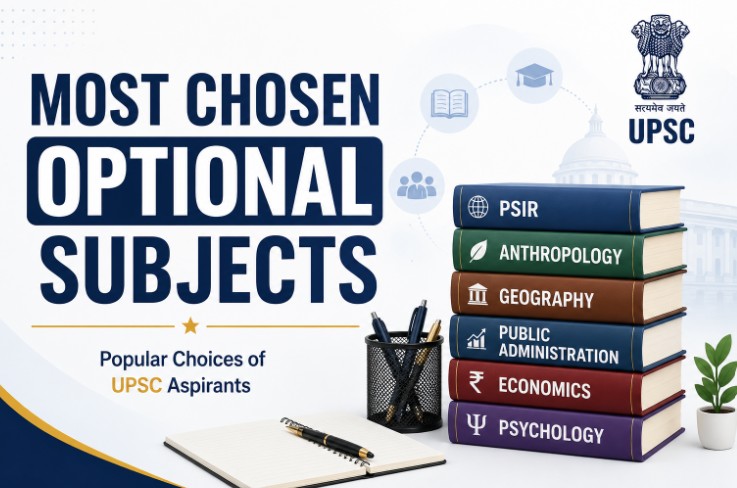
Most Chosen Optional Subjects
Eight subjects account for the bulk of every year’s optional choices. Here is what sets each one apart, beyond what any list can show.
1. Political Science and International Relations
Political Science and International Relations is one of those subjects that tends to favor those who are in the habit of studying foreign policy, parliament, and constitution-related issues.
Shakti Dubey, who secured AIR 1 in the CSE 2024 cycle, opted for PSIR and achieved 279 out of 500 marks in the subject, which is one of the highest optional scores of that year.
There is much similarity between the subject and GS Paper II, and therefore, time invested in PSIR yields a double benefit in the optional paper as well as GS paper.
However, this similarity can be a trap as candidates tend to merge static theory with current affairs and write subjective answers, which do not fetch many marks.
2. Sociology
Optional Sociology Rajeshwari Suve M scored All India Rank 2 in the CSE 2025 cycle, thereby ending a streak of success for Sociology as an optional.
However, this streak ended momentarily in the 2024 cycle. The average Sociology marks decreased by fifteen to twenty marks when compared to 2023, taking everyone in coaching institutes by surprise.
Sociology remains an easy optional for starters, but the above dip confirms that this optional is not exempt from any sudden changes in marking trends of the examiners.
3. Anthropology
In the case of anthropology, Anudeep Durishetty came first in the CSE 2017 cycle, with Anthropology being his optional subject, while Shubham Kumar did the same with All India Rank 1 in CSE 2020, earning 320 marks out of 500 in the subject.
For candidates opting for Anthropology, usually three to four months are sufficient to complete the syllabus, leaving all the remaining time for General Studies and Ethics.
Quality coaching for Anthropology is concentrated in very few cities, making it difficult for candidates from other cities to get good coaching.
4. Geography
In Geography, candidates who come from either a science or an engineering background tend to opt for Geography since it has a lot of benefit from using diagrams in the answer.
The popularity of Geography as a subject has seen a drastic decline in the last decade. While around 3,515 candidates opted for Geography in 2014, only about 1,079 candidates opted for it in 2021.
It continues to suit the correct candidate but not in the same numbers as before.
5. History
In History, Shruti Sharma was the topper in the CSE 2021 session with AIR 1, and she obtained 306/500 in History, which is one of the highest optional scores in recent times.
It covers history from ancient to medieval and then modern and even world history; thus, a superficial study becomes apparent from the very answers themselves.
History is an optional subject that is good for those who like reading and the subject itself.
6. Philosophy
Dongre Archit Parag got an AIR of 3 in CSE 2024 with Philosophy as his optional subject, which shows that philosophy can take you all the way up to the ranks.
Though the syllabus is small, the concepts covered in it are complex. Poor communication skills will convert the small syllabus of Philosophy into a low score very fast.
Philosophy is a subject where clarity of thought scores over breadth of reading in terms of scoring.
7. Public Administration
Public Administration: This is an area of study that focuses on government servants or people who are already aware of the administration system.
Just like Geography, Public Administration is one field whose number of candidates applying to it has been dwindling year after year because people prefer shorter syllabi.
This area of study favors innovative ideas, although years of routine textbook answers from fewer candidates have made such unique answers uncommon.
8. Commerce and Accountancy
Commerce & Accountancy: Akansh Dhull got AIR 3 in the CSE 2025 cycle by choosing Commerce & Accountancy, thus proving how this subject can score as effectively as much more popular ones.
Questions based on numbers/ calculations give less scope for subjective evaluation, which helps maintain uniformity while scoring.
However, the subject can be chosen only by those aspirants who have basic knowledge of finance/accountancy. Otherwise, the syllabus is very harsh on other candidates.
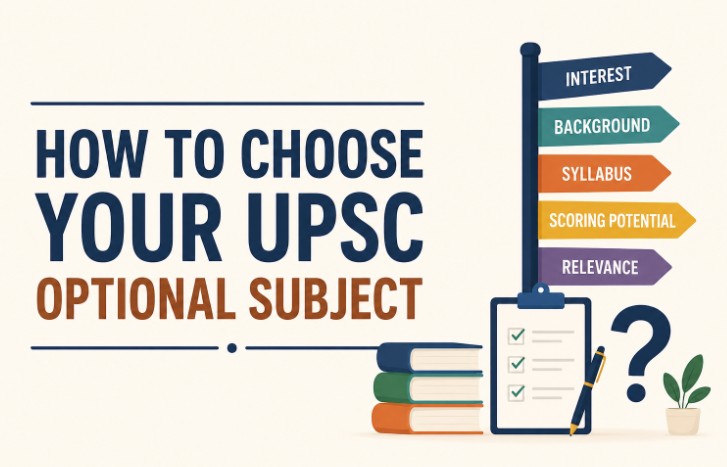
How to Choose Your UPSC Optional Subject
The choice of the right optional will depend on interest in the subject, its relation to GS, availability of study material, and past performance trends in the subject.
1. Interest in the Subject
If any subject is to be studied for a period of more than one year, then it should definitely continue to interest you.
This is indeed a very crucial point.
2. Study Materials Availability
You should ensure that:
Books, Previous year questions, test series, topper copies, etc. are available.
3. GS Overlap
There are subjects such as Geography, Sociology, PSIR, History, and Public Administration that can aid in preparing for GS. Thus, a lot of aspirants opt for such subjects.
4. Mentorship Availability
You will require adequate guidance or mentorship; this will enhance your performance significantly. Don’t ignore this point, since this factor is indeed very vital.
5. Answer Writing
Those subjects that contain analytical portions as well as diagram-based answers would help improve your scores. Thus, you can assign this criterion a high importance.
UPSC Optional Subject Success Rate
Success ratio refers to those applicants who were recommended for selection from among the applicants who appeared for that optional.
| Optional Subject | Approximate Success Rate | Why It Performs This Way |
|---|---|---|
| Anthropology | Around 9% to 11% | Short syllabus, high scoring potential |
| Political Science and International Relations | Around 8% to 10% | Strong overlap with GS Paper II |
| Sociology | Around 8% to 10% | Relatable themes, structured material |
| History | Around 4% to 8% | Long syllabus, rewards depth |
| Geography | Around 5% to 7% | Falling candidate numbers over the years |
| Philosophy | Varies widely by examiner | Short syllabus, needs sharp writing |
More Suggestions:
Conclusion: Choose the UPSC Optional That Fits You Best
It specifies that while popularity guarantees consistency, preparation leads to success. CSE 2025 saw 958 candidates with options being made from almost all 48 optional subjects.
The PSIR was amongst the top three popular optional subjects, along with Sociology and Anthropology, because of its relevance to the subject of General Studies.
On the other hand, 306/500 scored by Shruti Sharma in History (CSE 2021) is considered one of the best in recent times.
FAQs
A candidate can choose only one optional subject for the UPSC Civil Services Mains Exam. That subject carries two papers of 250 marks each in the Mains exam.
The optional subject carries 500 marks out of 1750 total Mains marks. That works out to close to 29% of the final written score.
A candidate can pick a different optional subject in a future exam cycle. Once the Mains application for a given year is submitted, that year’s choice is locked.
Philosophy, Sociology, and Anthropology are often called easier choices because their syllabi stay compact. Ease still depends on the individual candidate’s reading and writing style.