When you start preparing for the UPSC exam, the first question is usually simple: what subjects do I actually need to study? The syllabus looks massive, but the good news is that the compulsory subjects are fixed for every aspirant.
Whether you are an engineer, doctor, graduate in humanities, or from any other background, you prepare the same core papers in General Studies, Essay, and qualifying languages.
Understanding these compulsory subjects early helps you plan your preparation better because these papers carry the biggest share of marks in the final selection.
Let us break down the compulsory subjects for UPSC Prelims, Mains, and the Interview, so you know exactly what needs your attention.
How the UPSC Exam Is Structured
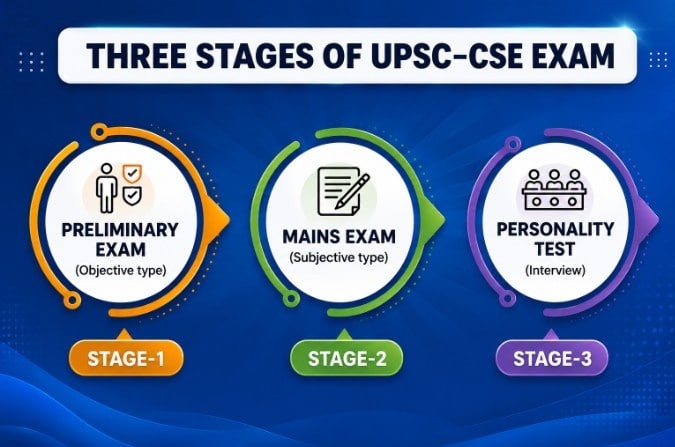
Before we talk about subjects, you need to understand the exam itself. The UPSC Civil Services Examination happens in three stages.
Stage 1: Preliminary Examination (Prelims)
This is a screening test. Two objective papers. You need to clear the cutoff to sit for Mains. Prelims marks are not added to your final score.
Stage 2: Main Examination (Mains)
This is where your rank is actually decided. Nine descriptive papers. Seven are compulsory, and two are from your chosen optional subject.
Stage 3: Personality Test (Interview)
A 275-mark conversation with a panel. No fixed syllabus, but your background, opinions, and awareness are tested.
So, how many subjects are compulsory for the UPSC exam across all three stages?
The answer is that every candidate, regardless of background, must prepare for the same set of General Studies papers in Prelims and Mains, along with two qualifying language papers and an Essay paper.
Now let us break this down stage by stage.
Compulsory Subjects in UPSC Prelims
The Prelims exam has two papers, both held on the same day. Both are objective (multiple-choice), and both are compulsory.
If you are wondering how many subjects in UPSC Prelims you need to cover, the answer is two papers, but Paper 1 alone covers six to seven broad areas.
Paper 1: General Studies (200 Marks)
This is the paper that counts. Your Prelims merit is decided solely by your Paper 1 score.
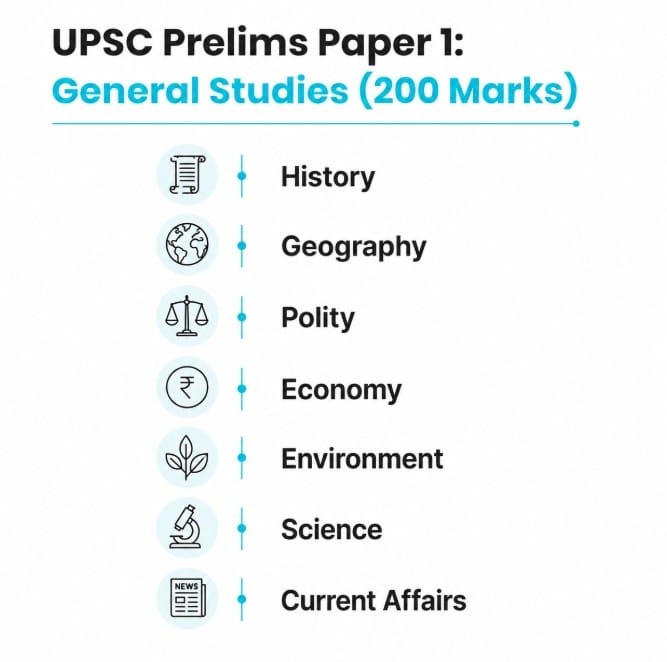
It covers the following areas:
| Area | What It Includes |
|---|---|
| History | Ancient, Medieval, Modern India, Indian National Movement |
| Geography | India and World, Physical, Social, Economic Geography |
| Polity | Constitution, Governance, Panchayati Raj, Rights and Issues |
| Economy | Economic Development, Budgeting, Banking, Growth and Planning |
| Environment | Ecology, Biodiversity, Climate Change, Environmental Issues |
| Science | General Science, Everyday Applications, Technology |
| Current Affairs | National and International Events of the past 12 months |
Every single topic here is compulsory. You cannot afford to skip any of them because UPSC does not announce how many questions will come from each area.
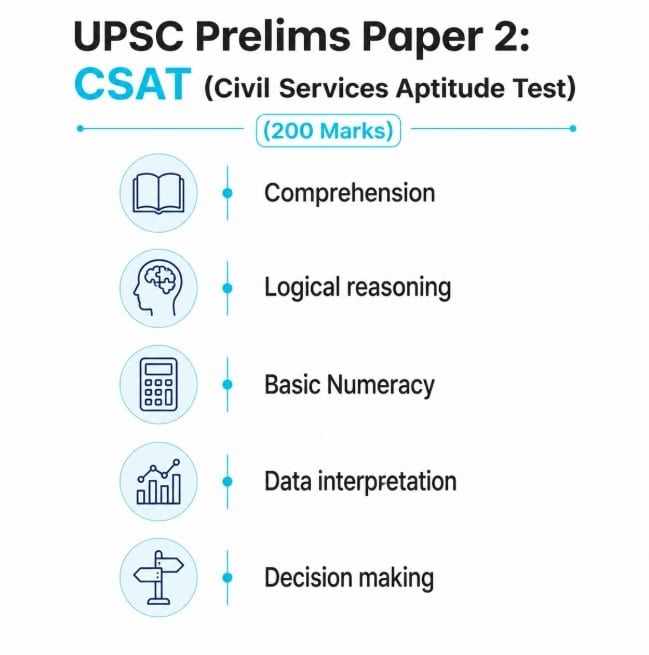
Paper 2: CSAT (Civil Services Aptitude Test) (200 Marks)
CSAT is a qualifying paper. You just need to score 33% (66 out of 200) to pass.
It covers comprehension, logical reasoning, basic numeracy, data interpretation, and decision-making.
Here is where many aspirants make a costly mistake. They ignore CSAT completely, assuming the 33% cutoff is easy.
But every year, thousands of candidates clear the GS cutoff and still fail Prelims because of CSAT. Spend at least a few weeks practising this paper, especially if your comfort with quantitative reasoning is limited.
Compulsory Subjects in UPSC Mains
This is the most important stage. Mains carries 1750 marks in total and determines your position in the final merit list.
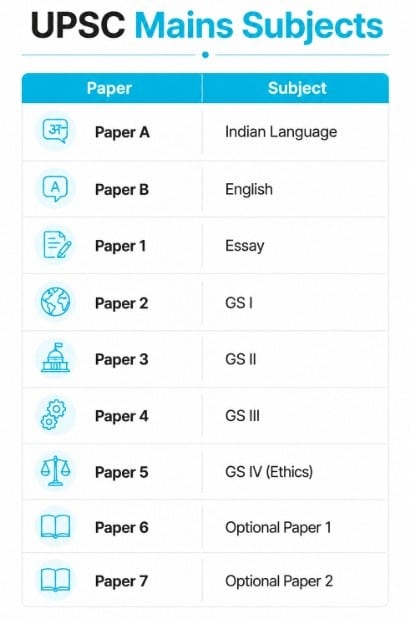
Let us look at all nine papers first, and then discuss the seven compulsory ones in detail.
| Paper | Subject | Marks | Counted for Ranking? |
|---|---|---|---|
| Paper A | Indian Language | 300 | No (Qualifying) |
| Paper B | English | 300 | No (Qualifying) |
| Paper 1 | Essay | 250 | Yes |
| Paper 2 | GS I | 250 | Yes |
| Paper 3 | GS II | 250 | Yes |
| Paper 4 | GS III | 250 | Yes |
| Paper 5 | GS IV (Ethics) | 250 | Yes |
| Paper 6 | Optional Paper 1 | 250 | Yes |
| Paper 7 | Optional Paper 2 | 250 | Yes |
Papers A and B are qualifying in nature. The compulsory merit-based papers are Papers 1 through 5, while Papers 6 and 7 belong to the optional subject chosen by the candidate.
So the list of compulsory subjects for the UPSC exam at the Mains stage includes: one Indian Language, English, Essay, and four General Studies papers including Ethics.
Let us now look at each one.
Paper A: Compulsory Indian Language (Qualifying)
You pick one language from the list in the Eighth Schedule of the Indian Constitution. There are 22 languages to choose from, including Hindi, Tamil, Bengali, Marathi, Telugu, Kannada, and others.
This paper tests basic writing ability: essay, letter writing, comprehension, and precis. The difficulty is roughly at a Class 10 level.
You must score the minimum qualifying marks, but this paper does not count toward your rank.
One important note: candidates from certain northeastern states, and those who studied in English medium from a recognized university, may be exempt from this paper. Check the UPSC notification carefully for the latest exemption rules.
Paper B: English (Qualifying)
Similar to Paper A, this is also a qualifying paper. It tests your ability to read and write in English at a functional level.
Topics include essay writing, comprehension passages, précis, and basic grammar usage.
Again, this does not add to your merit score. But failing this paper means disqualification, no matter how well you perform elsewhere. Do not take it lightly if English is not a language you use regularly.
Paper 1: Essay (250 Marks)
Many aspirants underestimate this paper. That is a mistake.
You will be given a choice of topics from two sections. You have to write one essay from each section. Each essay carries 125 marks.
Topics can range from philosophy and society to governance, technology, or international relations. There is no fixed syllabus. Your clarity of thought, structure, and expression matter more than memorized content.
This paper can make or break your rank. Toppers consistently say that regular essay practice, started early in preparation, gave them a clear edge.
Paper 2: General Studies I (250 Marks)
This paper covers three big areas: Indian Heritage and Culture, History, and Geography.
| Area | Topics Covered |
|---|---|
| Indian Culture | Art forms, Literature, Architecture from ancient to modern |
| History | Modern Indian History, the Freedom Struggle, Post-independence India, World History (events from the 18th century onward) |
| Geography | Physical Geography, Resource Distribution, Factors of Social and Economic Geography |
The Mains version goes deeper than Prelims. You are expected to write analytical answers, not just recall facts.
Paper 3: General Studies II (250 Marks)
This is often called the “Polity and Governance” paper, but it covers much more.
| Area | Topics Covered |
|---|---|
| Constitution and Polity | Amendments, Features, Fundamental Rights, Directive Principles, Federal Structure |
| Governance | Government Policies, E-governance, Transparency, Accountability |
| Social Justice | Welfare Schemes, Vulnerable Sections, Health and Education Issues |
| International Relations | India’s Foreign Policy, Bilateral and Regional Groupings, International Institutions |
Current affairs play a huge role in this paper. Almost every question can be linked to something that happened in the past year. Reading the newspaper daily is not optional here. It is essential.
Paper 4: General Studies III (250 Marks)
This is the most diverse paper among all the UPSC main subjects. It brings together economy, science, environment, and security into one paper.
| Area | Topics Covered |
|---|---|
| Economy | Indian Economy, Growth, Budgeting, Inclusive Growth, Agriculture |
| Science and Technology | Developments, Applications, Space, Biotech, IT |
| Environment | Conservation, Pollution, Environmental Impact Assessment |
| Disaster Management | Types, Mitigation Strategies, Institutional Framework |
| Internal Security | Challenges, Extremism, Border Management, Cyber Security |
This paper rewards candidates who can connect concepts across disciplines. For example, a question on food security might need you to link agriculture, government policy, and environmental sustainability in one answer.
Paper 5: General Studies IV, Ethics (250 Marks)
Ethics is the paper that surprises most aspirants, especially those from technical backgrounds.
It covers ethics, integrity, aptitude, and the values expected in public administration. A significant portion involves case studies where you are given a real-world dilemma and asked to suggest a course of action.
Topics include emotional intelligence, public service values, attitude, contributions of moral thinkers, and ethical issues in governance.
There is no single textbook for this. Reading case studies, practicing answer writing, and reflecting on administrative ethics from real scenarios is the best way to prepare.
Here is what makes this paper special: it is often the highest-scoring paper for candidates who prepare it well. Unlike GS I to III, where competition is tight and scoring above 120 is hard, many toppers have scored 130 or above in Ethics with focused preparation.
Compulsory Subjects in the UPSC Interview
The Personality Test carries 275 marks. There is no fixed syllabus, and no subject list applies here in the traditional sense.
The interview board picks questions based on your Detailed Application Form (DAF). This means your educational background, work experience, home state, hobbies, and interests are all fair game.
Current affairs, your opinions on national issues, and your ability to think on your feet also get tested.
Though there are no “compulsory subjects” for the interview, everything you studied for Mains forms the backdrop of this conversation. Candidates who have a solid hold on their GS papers tend to handle the interview better because the questions often follow the same themes.
Compulsory vs Optional Subjects: Clear the Confusion
This is where many new aspirants get confused. Let us settle it clearly.
Compulsory subjects are fixed. Every candidate studies the same General Studies papers, writes the same Essay paper, and takes the same qualifying language tests. You have no choice in these.
Optional subjects are different. For Mains, you pick one subject from a list of around 48 options (like History, Geography, Sociology, Public Administration, Mathematics, and others). This optional subject has two papers of 250 marks each.
The optional subject is important, but it is not the focus of this article. What matters most is that the compulsory papers carry 1250 marks out of the total 1750 in Mains. That is roughly 71% of your Mains score.
If you are spending 70% of your time on your optional and 30% on GS, you are doing it backwards. The compulsory papers deserve the larger share of your attention.
How to Approach the Compulsory Subjects Practically
Knowing the list of compulsory subjects for the UPSC exam is the easy part. The real challenge is figuring out how to study them. Here are a few strategies that actually work.
Start with NCERTs
Class 6 to 12 NCERTs for History, Geography, Political Science, and Economics give you a foundation that no coaching material can match.
They are written in simple language. They build concepts in order. And UPSC questions, especially in Prelims, are often drawn from these books.
Do not skip this step thinking it is too basic. Toppers across years have said the same thing: NCERTs come first.
Follow a Standard Booklist, but Keep It Short
For each subject, stick to one or two trusted sources. Here are the widely recommended ones:
| Subject | Recommended Book |
|---|---|
| Polity | M. Laxmikanth, Indian Polity |
| Economy | Ramesh Singh, Indian Economy |
| Modern History | Spectrum, A Brief History of Modern India |
| Geography | G.C. Leong (Physical) and NCERTs |
| Environment | Shankar IAS Environment |
| Ethics | Lexicon for Ethics (plus case study practice) |
Reading five books on one subject will not help you score more. Reading one book well, revising it, and practising questions from it will.
Make Current Affairs a Daily Habit
Almost every UPSC main subject, from Polity to Economy to International Relations, connects to current affairs.

Read one quality newspaper daily. Supplement it with a monthly current affairs compilation. Make short notes that link events to syllabus topics.
The candidates who score well in Mains are the ones who can place current events inside the framework of their GS preparation.
Practise Answer Writing Early and Often
This is the most overlooked step. You can know everything about a topic and still score poorly in Mains if your answers are not structured well.

Start writing answers within the first few months of preparation. Time yourself. Stick to word limits. Get your answers evaluated if possible. The ability to express what you know clearly and concisely is a skill. It does not develop overnight.
Common Mistakes Aspirants Make With Compulsory Subjects
After two decades of observing UPSC preparation trends, some mistakes come up again and again.
- Ignoring CSAT: Do not wait until the last week. Regular practice and mock tests can prevent avoidable Prelims failures.
- Treating language papers casually: Qualifying papers still require preparation. Practise enough to comfortably clear the cutoff.
- Skipping Ethics preparation: Start early. Ethics rewards clear thinking and consistent practice.
- Separating Prelims and Mains preparation: Use the syllabus overlap to prepare smarter and save revision time.
- Over-investing in the optional: Balance your time wisely. General Studies carries more total marks than the optional subject.
Conclusion: There are 9 Compulsory Subjects For UPSC Exam
The UPSC exam can feel overwhelming when you first look at the syllabus. But once you understand which subjects are compulsory and how they are spread across Prelims, Mains, and the Interview, the picture becomes much clearer.
Focus your energy on mastering these compulsory papers because they carry the majority of the marks. Build a steady routine around GS, Essay, and Ethics.
Let your optional add to your score, not substitute for weak fundamentals. Start early, stay consistent, and trust the process.
FAQs
Across Prelims and Mains, there are 9 compulsory papers. In Prelims: GS and CSAT. In Mains: one Indian Language, English, Essay, and four GS papers (including Ethics). All candidates must appear for these.
No. Mathematics is an optional subject, not a compulsory one. The only quantitative component in the compulsory papers is basic numeracy in the CSAT paper, which is at a Class 10 level.
No. Both Paper A (Indian Language) and Paper B (English) are mandatory. Failing to qualify in either means your other papers will not be evaluated.
No. CSAT is qualifying. You need 33% (66 marks out of 200), but the score does not count toward your Prelims merit.
Ethics (GS Paper IV) is widely considered the most scoring compulsory paper. With focused preparation and good case study practice, candidates regularly score above 120 in this paper.
Yes, at a general level. Science and Technology is part of both Prelims GS and Mains GS Paper III. But the focus is on applications and awareness, not textbook science.
Two papers are compulsory: General Studies Paper 1 (which covers seven broad areas) and CSAT Paper 2. Only Paper 1 marks count for merit.