The IAS exam, officially known as the UPSC Civil Services Examination, tests candidates across three stages: Prelims, Mains, and Interview.
The structure includes 11 papers (2 in Prelims + 9 in Mains) and a Personality Test, with 48 optional subjects to choose from. It looks daunting, but the syllabus is structured and manageable.
This article breaks down every subject across all three stages, so you know exactly what to study, in what order, and how to pick the right optionals for your preparation.
IAS Subjects List 2026 (Prelims, Mains & Optional Overview)
Before going into each stage separately, here is a one-table snapshot of the full exam structure, marks, and the role each stage plays.
| Stage | Papers | Marks | Nature |
|---|---|---|---|
| Prelims | 2 (GS Paper I + CSAT) | 400 | Screening only |
| Mains | 9 papers | 1750 (merit) + 600 (qualifying) | Merit ranking |
| Interview | Personality Test | 275 | Final selection |
The marks that count toward your final rank are: 7 merit-based Mains papers (1750 marks) + Interview (275 marks) = 2025 marks total.
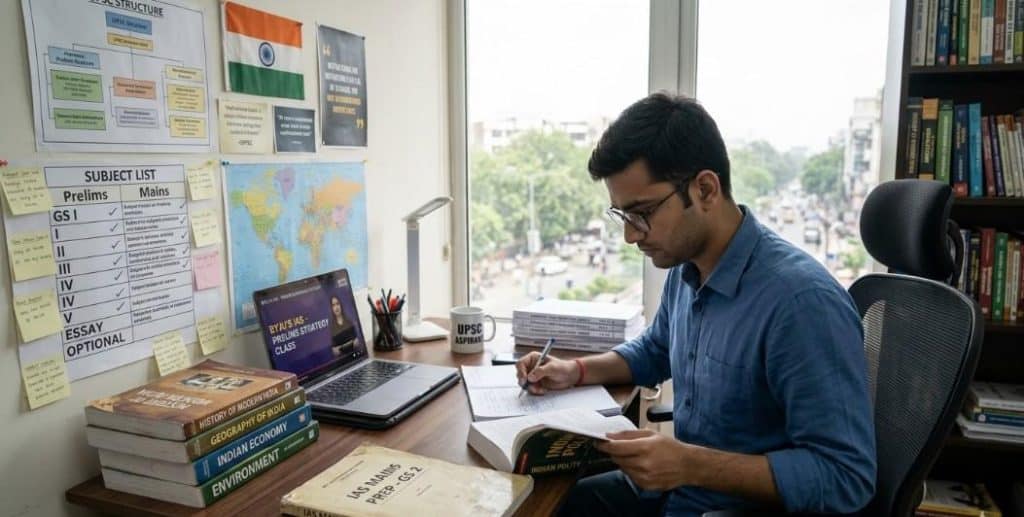
Prelims filter candidates, while Mains decides your rank. Knowing this distinction helps you allocate your study hours correctly from week one.
UPSC Prelims Subjects List 2026 (GS Paper I & CSAT Syllabus)
The UPSC Prelims subjects list covers two papers held on the same day. GS Paper I is merit-based, and CSAT is qualifying.
Before you sit for Prelims, you must meet the basic IAS exam eligibility criteria: a graduate degree from a recognised university, Indian citizenship, and age between 21 and 32 years for General category candidates.
GS Paper I Subjects
- Current Affairs
- History (Ancient, Medieval, Modern)
- Geography (Indian + World)
- Indian Polity & Constitution
- Economy
- Environment & Ecology
- Science & Technology
CSAT (Paper II) Subjects
- Comprehension
- Logical Reasoning & Analytical Ability
- Quantitative Aptitude (Class X level)
- Decision Making & Problem Solving
Note: CSAT is a qualifying paper. You need 33% (66 out of 200) to clear it. CSAT marks are not added to the Prelims merit list.
Most candidates clear CSAT with two to three weeks of focused practice.
UPSC Mains Subjects List 2026 (All 9 Papers Explained)
Clearing Prelims earns you a seat at Mains. This is where the real competition begins. The UPSC Mains subjects list carries the full weight of your selection, and your written answers here determine your final rank.

Compulsory Papers (Qualifying)
These two papers do not count toward your merit score, but you must clear both to move forward. If you fail either paper, UPSC will not evaluate your remaining seven papers, regardless of how well you wrote them.
- Paper A: Indian Language (any of the 22 scheduled languages from the 8th Schedule).
- Paper B: English.
Each paper carries 300 marks. You must score a minimum of 25% (75 out of 300) in each to qualify. Candidates from Arunachal Pradesh, Manipur, Meghalaya, Mizoram, Nagaland, and Sikkim are exempt from Paper A.
Merit-Based Papers (Core Subjects)
These 7 papers directly determine your rank. Make them your primary focus throughout preparation.
| Paper | Subject | Marks |
|---|---|---|
| Essay | Essay Writing (2 essays) | 250 |
| GS I | History, Indian Society, Geography | 250 |
| GS II | Polity, Governance, International Relations | 250 |
| GS III | Economy, Technology, Environment, Security | 250 |
| GS IV | Ethics, Integrity, Aptitude | 250 |
| Optional I | Chosen Optional Subject Paper 1 | 250 |
| Optional II | Chosen Optional Subject Paper 2 | 250 |
GS IV (Ethics) consistently separates high scorers from average ones in the UPSC Mains subjects list. Never treat it as secondary. Many candidates lose their rank here by underestimating its depth.
UPSC Optional Subjects List 2026 (All 48 Subjects)
UPSC offers 48 optional subjects across humanities, science, commerce, and literature. Each optional carries 2 papers worth 250 marks each, totaling 500 marks in the final merit count.
The table below covers the major categories from the IAS optional subjects list with representative examples:
| Category | Subject Examples |
|---|---|
| Humanities | History, Sociology, Political Science & IR, Public Administration, Geography, Philosophy, Psychology |
| Science | Physics, Chemistry, Mathematics, Botany, Zoology, Agriculture, Medical Science |
| Commerce | Commerce & Accountancy |
| Literature | Hindi, English, Sanskrit, Urdu, Tamil, Telugu, Bengali, and other 8th Schedule languages |
Choose your option based on your graduation background, genuine interest, and past scoring trends. A subject you understand deeply will always outperform one chosen only by reputation.
UPSC Prelims vs Mains Subjects (Key Differences Explained)
Both stages test knowledge, but they test it in entirely different ways. Knowing these differences early helps you build a preparation strategy that works for both stages at the same time, rather than preparing for each in isolation.
| Feature | Prelims | Mains |
|---|---|---|
| Format | Objective (MCQ) | Descriptive (written answers) |
| Purpose | Screening | Merit ranking |
| Approach | Breadth of knowledge | Depth and analysis |
| CSAT | Qualifying at 33% | Not applicable |
| Total merit marks | 0 (screening only) | 1750 |
The practical approach is to study core subjects like Polity, History, and Economy at Mains depth, while running Prelims MCQ practice alongside throughout the year. This builds both skills without splitting your schedule.
Which Subjects to Start First for UPSC Preparation (Beginner Guide)
Start with Polity, History, and Current Affairs. These three subjects cut across both Prelims and Mains, giving you the highest return on study time during the early months of your UPSC preparation.
- Polity (M. Laxmikanth): Appears in GS Paper I at Prelims, GS II at Mains, and threads through Ethics as well. No other subject connects as many papers.
- History: Static, well-defined content with strong scoring potential. Modern History directly overlaps with Art & Culture and Society in Mains GS I, so the time spent here pays twice.
- Current Affairs: Read a reliable source every day without exception. UPSC integrates current affairs into every GS paper at both stages, and candidates who skip this discipline consistently underperform.
Focus on the syllabus overlap between Prelims and Mains from day one. Studying a topic once, but at the right depth, means you cover both stages in a single pass.
According to interviews with UPSC toppers, candidates who built their Polity and History base in the first three months of preparation performed consistently better across both stages.
Conclusion: Polity, History, & Current Affairs Are The First IAS Subjects To Master
The IAS syllabus is large, but it follows a clear pattern: 2 Prelims papers, 9 Mains papers, and 48 optional subjects. Every paper has a defined role. Prelims screens, Mains ranks, and the Interview test your personality and judgment.
Start with Polity and History because they overlap the most across stages. Pick your optional early and stay consistent. Build your Current Affairs habit from day one.
With a structured sequence and daily effort, this syllabus becomes something you can master, one paper at a time.
FAQs
The IAS exam covers 11 papers (2 Prelims + 9 Mains) plus one optional subject chosen from a list of 48.
Three months is not enough for a first attempt; most successful candidates prepare consistently for 12 to 18 months.
The 7 merit-based Mains papers are Essay, GS I, GS II, GS III, GS IV, Optional Paper I, and Optional Paper II, each carrying 250 marks.
A rank around 1000 typically qualifies for lower Group A Central Services such as AFHQCS; top services like IAS, IPS, and IRS require significantly higher ranks in the General category.
UPSC Prelims has 2 papers: GS Paper I (merit-based, 200 marks) and CSAT Paper II (qualifying, 200 marks, minimum 33% to clear).