The UPSC Civil Services Exam for 2026 is conducted in three different phases. Candidates qualify for each phase, starting with the Preliminary phase, followed by the Main phase, and finally the Interview phase.
Each of these phases has its own distinct structure of papers, marking system, and importance in the final merit list. This post describes the structure of all three phases.
UPSC CSE Exam Pattern: Overview and Stages
The pattern of the exam is released every year through the official notification of the Civil Services Examination. The notification for 2026 was released on 4th February 2026.
The examination process consists of three levels – Preliminary Examination, Main Examination, and Personality Test.
| Stage | Type | Marks | Role in Selection |
|---|---|---|---|
| Preliminary Exam | Objective (MCQ) | 400 (200 + 200) | Screening only; not counted in final merit |
| Main Exam | Descriptive (Written) | 1750 (merit papers) | Counted in final merit |
| Interview | Personality Test | 275 | Counted in final merit |
Preliminary Examination is just a selection process and helps to select the candidate for the Mains Examination. There are no marks for the Preliminary Examination at all.
Marks allotted to the Mains Examination are 1750, and that to the interview are 275. The total marks will be 2025, and this will form the merit list.
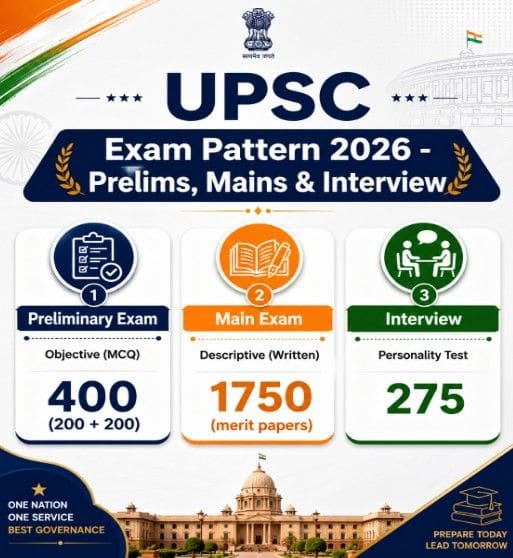
Those who clear the preliminary examination appear in the mains examination. Those who clear the Mains Examination sit for the interview.
Ultimately, the final list of ranks for IAS, IPS, IFS, etc. will be prepared by UPSC according to the marks obtained in the Mains and Interview examinations.
UPSC Prelims Exam Pattern
There are two papers in the Prelims examination. Both are of objective type and evaluated using machines.
| Paper | Subject | Questions | Marks | Duration | Nature |
|---|---|---|---|---|---|
| Paper I | General Studies | 100 | 200 | 2 hours | Counts toward Prelims cutoff |
| Paper II | CSAT | 80 | 200 | 2 hours | Qualifying (33% minimum) |
GS Paper 1 carries 2 marks for each question. CSAT carries 2.5 marks for each question. Therefore, only GS Paper 1 marks determine who will qualify for Mains, because CSAT is qualifying in nature and does not contribute to the cutoff marks.
UPSC releases the Prelims Roll Number Result (the list of candidates qualified for Mains) within 2 to 3 weeks after the exam. What UPSC holds back until the final selection list is published is the Official Prelims Answer Key, Cutoff Marks, and Individual Scorecards.
UPSC Mains Exam Pattern
The following table shows that the Mains consists of nine papers divided over five to six days. Out of these, seven papers are considered merit papers. The other two papers are qualifying papers.
| Paper | Subject | Marks | Nature |
|---|---|---|---|
| Paper A | Indian Language | 300 | Qualifying |
| Paper B | English | 300 | Qualifying |
| Paper I | Essay | 250 | Merit |
| Paper II | General Studies I | 250 | Merit |
| Paper III | General Studies II | 250 | Merit |
| Paper IV | General Studies III | 250 | Merit |
| Paper V | General Studies IV | 250 | Merit |
| Paper VI | Optional Subject I | 250 | Merit |
| Paper VII | Optional Subject II | 250 | Merit |
All merit papers will have three hours each assigned to them. Blind candidates will have an extra thirty minutes for each paper.
Students from regions such as Arunachal Pradesh, Manipur, Meghalaya, Mizoram, Nagaland, and Sikkim can be exempt from the Indian language paper with proper evidence.
UPSC offers 26 subjects and 23 literature languages, 49 choices in total (48 in some traditional lists). Candidates choose one optional subject with two papers of 250 marks each.
UPSC Interview Test Pattern
The interview is the last stage, where the entire selection process is completed. This stage is conducted by a panel of experienced members, and its duration is 20 to 30 minutes. Its weightage is 275 marks.
The panel tests mental awareness, decision-making abilities, the ability to think clearly, and the ability to handle stress.
UPSC takes into account the interview marks as well as Mains marks to determine the merit list, which comprises 2025 marks.
UPSC Syllabus
The syllabus will provide the list of subjects that need to be covered by the aspirant. The pattern provides only the format and marks allotted to the paper. Given below is a brief outline of the topics for each stage:
- Prelims GS Paper I: Current affairs, History of India, Geography, Polity, Economy, Environment & General Science.
- CSAT Prelims: Comprehension, Logical Reasoning, Basic Numeracy and Decision Making.
- Mains GS I: Heritage, Culture, History & Geography.
- Mains GS II: Polity, Governance, Social Justice & International Relations.
- Mains GS III: Economy, Environment, Security & Disaster Management.
- Mains GS IV: Ethics, Integrity and Aptitude.
- Optional subject: From 48 subjects; Two Papers based on the selected subject.
The syllabus for the complete set of topics in a topic-wise manner is present in the UPSC official notification PDF available at upsc.gov.in.
UPSC Negative Marking Rules
Negative marking is there in Prelims only. There is no negative marking in the Mains exam, as all questions are descriptive in that.
- Candidates need to score a minimum of 33% in CSAT (which equates to 66.66 marks out of 200) to qualify for GS Paper-I evaluation.
- CSAT Paper-II: For each wrong answer, the UPSC will deduct one-third of the marks allotted to that question, i.e., 0.833 marks per question.
- No deduction for an unattempted question.
- If an aspirant attempts more than one answer to a particular question, the UPSC will treat it as incorrect, regardless of whether any of the answers is correct.
Difference between UPSC Exam Pattern and UPSC Syllabus
Aspirants often mix up pattern and syllabus. They serve two different purposes in exam preparation.
| Aspect | Exam Pattern | Syllabus |
|---|---|---|
| What it covers | Paper structure, marks, duration, marking scheme | Topics and subject matter to study |
| Purpose | Tells you how the exam is organised | Tells you what to study |
| Changes | Rarely changes year to year | Can shift slightly with new notifications |
| Where to check | UPSC CSE Notification, exam pattern page | UPSC CSE Notification, syllabus annexure |
The pattern is necessary for the candidate to plan his/her time, paper, and strategy. The syllabus is necessary for the candidate to know which topics and books he/she should study.
Both documents are issued through the UPSC notification, but they serve different purposes.
Conclusion: UPSC- A Three-Stage Filter
UPSC considers the Preliminary, Main, and Interview exams as three distinct phases, which test various skills.
However, a good performance in the Preliminary phase alone will not be sufficient for selection if either the Mains or the Interview phase is poor.
The total written Mains stage is 1,750 marks. The Optional Subject comprises 500 marks (2 papers of 250 marks each) within that 1,750-mark total.
FAQs
The Preliminary Examination is objective (MCQ-based). The Main Examination is the descriptive/subjective stage. It comprises two papers that are both taken in the OMR offline mode on the same day. In contrast, Paper I tests general knowledge and current affairs, whereas Paper II, or CSAT, tests aptitude. Only marks in Paper I decide the cut-off for qualifying in Mains.
The 7-5-3 Rule ensures that the UPSC aspirant can skillfully construct answers through time management, proper organization, and multi-dimensional analysis. The rule emphasizes planning, mentioning important points, and explaining them multi-dimensionally.
In the UPSC Prelims pattern of examination, there are two papers: GS Paper 1 and CSAT. Both these papers consist of objective-type questions. In these two papers, the negative marking scheme is as follows: For every wrong answer marked, the candidate loses 1/3rd of the marks allotted to the question.
No. Only the Prelims objective papers carry a penalty for wrong answers.