
One wrong tick on the OMR sheet costs you more than zero. It pulls your score backwards. That single reality changes how lakhs of aspirants approach the UPSC Prelims every year.
If you are preparing for the Civil Services Exam, understanding negative marking in UPSC is not optional. It directly decides whether you clear the cutoff or miss it by a painful half-mark margin.
This article breaks down exactly how the penalty works, when it applies, and most importantly, how to use it to your advantage instead of fearing it.
What Is Negative Marking in UPSC?
Negative marking means a portion of marks is deducted for every wrong answer you select.
UPSC uses this system only in the Prelims stage, which is entirely objective (multiple choice). The logic is straightforward. Without any penalty, a candidate could randomly mark all 100 questions and still score around 50 out of 200 by sheer luck. That would defeat the purpose of a screening exam.

So UPSC deducts one-third of the marks allotted to a question for every incorrect response. This ensures that only candidates with genuine knowledge move ahead.
Unattempted questions carry no penalty at all. Leaving a question blank neither adds to nor subtracts from your score.
Where Does Negative Marking Apply (and Where It Does Not)?
This is where many aspirants get confused. So let’s clear it up with a quick table.
| Stage | Format | Negative Marking? |
|---|---|---|
| Prelims GS Paper 1 | MCQ (100 questions) | Yes, one-third penalty |
| Prelims CSAT (Paper 2) | MCQ (80 questions) | Yes, one-third penalty |
| Mains (all papers) | Descriptive/written | No |
| Interview/Personality Test | Oral assessment | No |
Negative marking in UPSC Prelims applies to both papers. Many candidates focus only on GS Paper 1 and treat CSAT casually. That is risky. The same penalty rules apply to CSAT, and reckless guessing there can push you below the qualifying threshold of 33%.
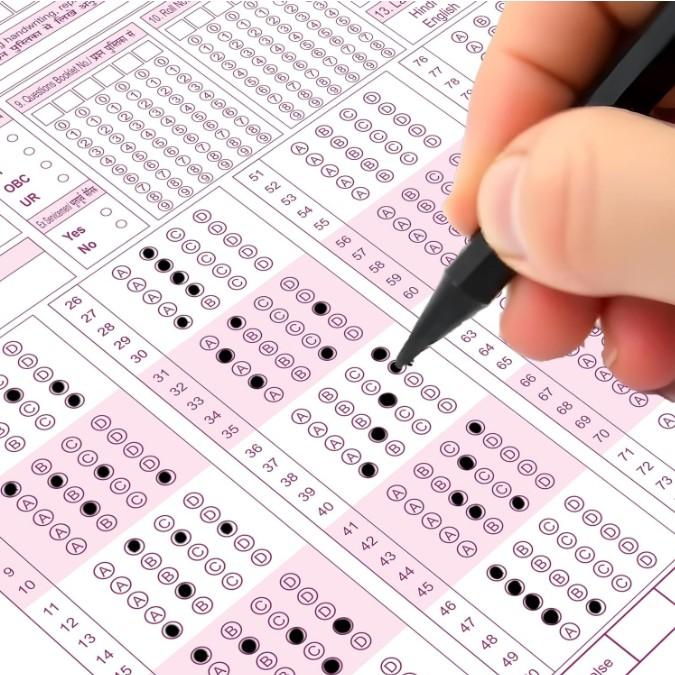
There is no negative marking in UPSC Mains. Since the papers are descriptive, candidates are evaluated on content, structure, and depth. Wrong arguments only result in lower marks.
This distinction matters. Carrying a Prelims penalty mindset into Mains can make candidates hesitant. Mains rewards clear expression, analysis, and well-developed answers.
How to Calculate Negative Marking in UPSC Prelims
Let’s get into the actual math. It is simpler than it looks.
For GS Paper 1, each question carries 2 marks. There are 100 questions, making the total 200 marks.
Here is the marking scheme:
| Action | Marks |
|---|---|
| Correct answer | +2.00 |
| Wrong answer | -0.66 (one-third of 2) |
| Unattempted | 0 |
For CSAT (Paper 2), each question carries 2.5 marks. There are 80 questions, totalling 200 marks.
| Action | Marks |
|---|---|
| Correct answer | +2.50 |
| Wrong answer | -0.83 (one-third of 2.5) |
| Unattempted | 0 |
A Simple Example
Let’s say you attempt 80 questions in GS Paper 1. You get 60 right and 20 wrong.
Step 1: Marks from correct answers = 60 x 2 = 120
Step 2: Penalty from wrong answers = 20 x 0.66 = 13.2
Step 3: Final score = 120 – 13.2 = 106.8
Now compare this with a candidate who attempts all 100 questions, gets 65 right but 35 wrong.
Marks from correct answers = 65 x 2 = 130
Penalty = 35 x 0.66 = 23.1
Final score = 130 – 23.1 = 106.9
Notice something? The second candidate attempted 20 more questions and got 5 more correct answers, yet scored almost the same. Those extra wrong answers nearly wiped out the benefit of the extra correct ones. That is how negative marking in UPSC works against reckless attempting.
Knowing how to calculate negative marking in UPSC is not just an academic exercise. It helps you set realistic targets during mock tests and on exam day.
How Many Questions Should You Actually Attempt?
There is no fixed number that works for everyone. But there is a framework that helps you decide in real time.
Your goal is not to attempt the most questions. Your goal is to maximise your net score. Those are two very different things.
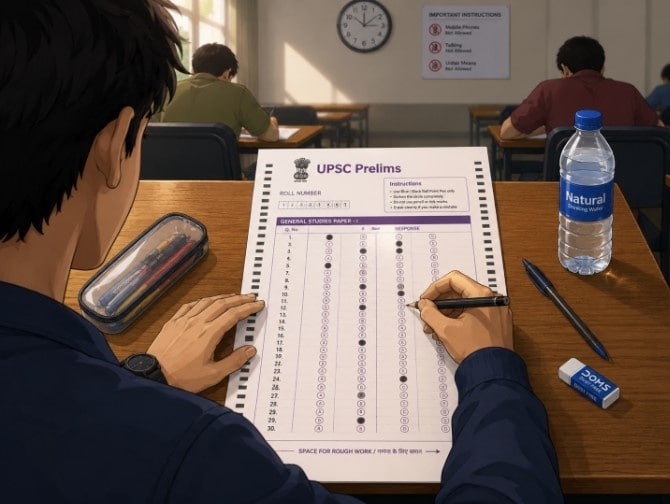
A good starting point for most well-prepared candidates is attempting 70 to 85 questions with high confidence. This typically yields a safer and often higher net score than attempting 95 questions with shaky confidence on 20 of them.
But the real skill lies in knowing when a calculated guess is worth it.
The Elimination Rule: When Guessing Becomes Smart
Every Prelims question gives you four options. If you have zero idea and guess randomly, your probability of being right is 25%.
Given the one-third penalty, the expected outcome of a pure guess is negative. Over many questions, random guessing will always drag your score down.
But what happens when you can eliminate options?
| Options Eliminated | Remaining Choices | Chance of Being Right | Should You Attempt? |
|---|---|---|---|
| 0 | 4 | 25% | No. Expected value is negative. |
| 1 | 3 | 33% | Borderline. Still risky overall. |
| 2 | 2 | 50% | Yes. The odds are now in your favour. |
| 3 | 1 | 100% | Obviously yes. |
If you can confidently rule out two options, attempting that question is a statistically positive decision. Over 10 such questions, you will gain more from the ones you get right than you lose from the ones you get wrong.
Practise this during mocks. After every test, review the questions you skipped and check how many of them had two clearly wrong options. That review builds the instinct you need on exam day.
Common Mistakes Candidates Make Around Negative Marking
Knowing the rules is one thing. Applying them under pressure is another. Here are the patterns that cost candidates the most.
- Being too cautious: Attempting only 55–60 questions due to fear of negative marking can hurt your score. Attempt questions where you have reasonable confidence.
- Last-minute panic guessing: Randomly filling answers in the final minutes usually backfires. Avoid blind guesses.
- Changing answers unnecessarily: Change an answer only with a clear reason, not due to anxiety or doubt.
- Ignoring CSAT: Treat CSAT seriously. Careless guessing can reduce your score below the qualifying mark.
A Smart Strategy to Handle Negative Marking in UPSC Prelims
Strategy is not something you build on exam day. It is something you practise for months before it.
- Practice with OMR mocks: Get used to solving and marking answers under real exam conditions.
- Track accuracy: Aim for consistent accuracy. Below 65% means you may be attempting too many uncertain questions.
- Use the two-pass method: First attempt sure-shot questions, then revisit skipped ones using elimination.
- Build subject confidence: Be more aggressive in strong areas and cautious in weaker ones.
- Set an attempt range: Decide a target range before mocks to avoid over-attempting or under-attempting.
Conclusion: Negative Marking in UPSC Rewards Careful Decision-Making, Not Avoidance
Many aspirants treat the penalty as a threat. But candidates who clear Prelims year after year see it differently. They see it as a system that rewards preparation, self-awareness, and composure under pressure.
You don’t need to get every question right. You don’t need to attempt every question either. What you need is the ability to tell the difference between “I have a reasonable chance here” and “I am purely guessing.”
Build that ability through mock tests, track your accuracy honestly, and trust the strategy you have practised. Negative marking is not a trap. With the right approach, it actually works in favour of the candidate who has done the work.
FAQs
Negative marking means a portion of marks is deducted for every wrong answer. In UPSC Prelims, one-third of the marks assigned to a question are deducted for an incorrect response.
Yes, negative marking applies to both Prelims papers. Many candidates focus only on GS Paper 1 and ignore CSAT, but careless guessing can affect their qualifying chances.
In GS Paper 1, a wrong answer costs 0.66 marks, while in CSAT, the penalty is 0.83 marks for every incorrect response.
No. Negative marking should make you strategic, not overly cautious. If you can eliminate options or have reasonable confidence, attempting the question can improve your net score.
Build accuracy through mocks, analyse mistakes, and develop a clear attempt strategy. The goal is not attempting the most questions but maximising your final score.