UPSC does not require a specific degree for the Civil Services Examination. A degree from any recognized university is required in UPSC.
But most aspirants want to know which stream gives the best preparation advantage.
This article compares Arts, Science, and Commerce degrees on syllabus overlap, optional subject suitability, and career backup, so you can make a sharper, more informed decision before you start preparing.
Is There a Best Degree for IAS According to UPSC?
According to the UPSC Civil Services Examination Rules, any candidate holding a graduation degree from a recognized university is eligible to apply. UPSC does not give preference to any stream or degree at any stage of selection.
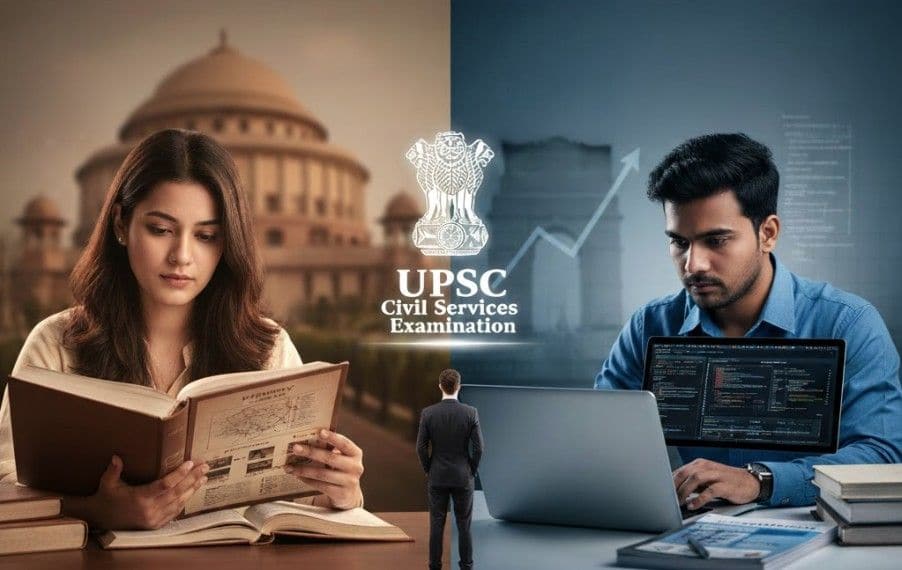
What actually determines your result is your optional subject choice, your command over the General Studies syllabus, and how consistently you prepare.
Many graduation subjects overlap directly with UPSC topics, which gives some students a measurable head start.
Which Degree Is Best for IAS After 12th? (Stream Comparison)
Your graduation stream shapes how quickly you adapt to the UPSC syllabus. The right degree reduces preparation time and supports your optional subject selection.
Here is a comparison of popular degrees against their specific advantages for UPSC preparation.
| Degree/Stream | UPSC Preparation Advantage | Backup Career |
|---|---|---|
| BA (Political Science, History, Geography) | High GS syllabus overlap | Teaching, academia |
| B.Tech / Engineering | Strong analytical skills, CSAT advantage | Engineering, tech jobs |
| MBBS / Medical | High discipline, stress management | Medical profession |
| B.Com / Economics | Helps in the economy and governance topics | Finance, banking |
No single degree guarantees selection. Each stream brings a distinct strength, and your final choice should match both your interest and your preparation strategy.
Which Degree Has the Highest Success Rate in UPSC?
Humanities graduates appear most frequently in UPSC results because their graduation subjects overlap directly with the GS syllabus.
Engineering graduates, however, consistently appear in the top ranks due to their strong analytical and problem-solving abilities.
The results reflect this clearly. Tina Dabi (AIR 1, CSE 2015) studied Political Science. Kanishak Kataria (AIR 1, CSE 2018) was a Computer Science engineer from IIT Bombay.
Shakti Dubey (AIR 1, CSE 2024) holds an M.Sc. in Biochemistry and chose Political Science and International Relations as her optional subject.
Three different streams. Three AIR 1 ranks. This makes one fact clear: preparation depth matters more than which degree you hold.
UPSC does not publish official success rates by stream or degree, so no stream can be statistically declared the best.
Best Graduation Subjects That Help in IAS Preparation
Picking the right subjects during graduation directly reduces your UPSC preparation workload.
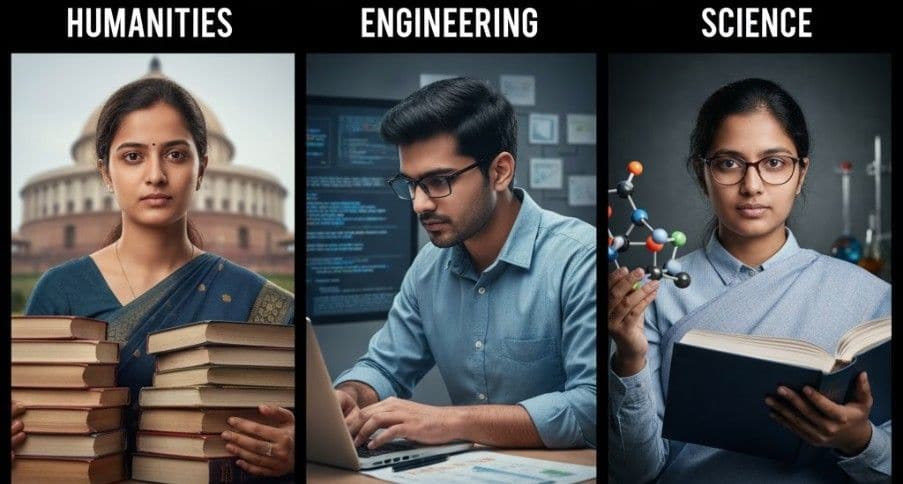
Several subjects across Humanities, Science, and Commerce streams align closely with the UPSC General Studies syllabus, making them practical choices for aspirants who want to prepare alongside their degree.
Humanities Degrees with Maximum UPSC Syllabus Overlap
These subjects cover large portions of GS Papers 1, 2, and 3 directly:
- Political Science– Covers polity, governance, and international relations.
- History– Matches GS Paper 1 directly and works as a strong optional subject.
- Geography– Useful across GS Paper 1 and environment-related topics.
- Sociology– A widely chosen optional with a direct overlap with social issues.
- Public Administration– Covers governance, policy, and administrative theory.
Science and Commerce Degrees That Still Work Well
These streams offer different but equally useful preparation advantages:
- Engineering (B.Tech)– Builds analytical thinking and makes the CSAT paper significantly easier.
- MBBS– Builds strong study discipline and supports science and technology topics in GS Paper 3.
- Economics / B.Com– Supports GS Paper 3 topics, including budgets, fiscal policy, and economic planning.
The UPSC General Studies syllabus is available on the official website at upsc.gov.in. Cross-referencing your graduation subjects with this syllabus is a practical way to identify overlap before you choose your stream.
Choosing the Right Degree for IAS Preparation (Strategy)
Your degree is a starting point, not a deciding factor. What matters is whether your chosen stream keeps you engaged for three to four years while building a foundation that supports UPSC preparation.
- Choose a subject you can study seriously for 3 to 4 years.
- Prefer subjects that can become your UPSC optional.
- Keep a career backup in mind, since UPSC takes multiple attempts for most candidates.
- Pick based on genuine interest, not based on what others are doing.
- Focus on consistency over the long term, not on finding shortcuts.
Students who choose a degree they connect with tend to stay consistent longer. In UPSC preparation, that consistency is the single most important factor separating those who clear the exam from those who do not.
Also Read:
Conclusion: For IAS, Any Graduation Degree Paired With Smart Preparation Is Best
UPSC accepts any graduation degree. No stream guarantees selection.
Humanities students benefit from the GS syllabus overlap. Science students handle CSAT more easily. Commerce students bring economic reasoning to GS Paper 3.
Choose a degree that supports your optional subject, keeps a career backup open, and holds your interest for years. Consistency beats the degree every time.
FAQs
Shakti Dubey pursued Biochemistry at the postgraduate level and took Political Science and International Relations as her optional subjects.
Both serve different goals entirely. IAS offers administrative authority and public service work, while IIT leads to technical and research careers. Your interests and long-term goals decide which path suits you better.
Delhi University and JNU are popular choices among UPSC aspirants. Subject alignment with the UPSC syllabus and access to study resources matter more than the university’s overall ranking.
Complete graduation in any stream from a recognized university, then appear for UPSC CSE. Starting preparation from your second or third year of graduation gives you a stronger foundation before your first attempt.