
Indian Administrative Service (IAS) officers get a pension, but which system applies depends on when they joined.
However, the pension system changed completely on January 1, 2004, when the government replaced the Old Pension Scheme (OPS) with the National Pension System (NPS).
More recently, the Unified Pension Scheme (UPS), which was launched in August 2024, has changed retirement benefits again.
This article explains who gets what pension, how much they receive, how it’s calculated, and what makes each scheme different.
Do IAS Officers Get Pension? (Quick Answer)
All IAS officers get pension benefits, but the type depends on when they joined service. The Indian Administrative Service (IAS) is the main civil service of the Government of India.

Pension rules are set by either the Old Pension Scheme (for officers who joined before January 1, 2004) or the National Pension System (for those who joined after this date).
IAS Pension Under Old Pension Scheme (Before 2004)
Officers who joined the IAS before January 1, 2004, still enjoy a secure system where their retirement income is fixed and guaranteed by the government. This scheme gives a predictable income that adjusts for inflation, and officers don’t need to pay anything from their salary during their working years.
Eligibility Criteria
To get a full pension under OPS, officers must have joined before January 1, 2004, and worked for at least 20 years as per Rule 49 of CCS (Pension) Rules, 1972.
Officers who retire between 10 and 20 years get reduced benefits based on how long they worked. The salary structure of the IAS officer follows the recommendations of the 7th Central Pay Commission, ranging from Level 10 (Assistant Collector) to Level 17 (Cabinet Secretary).
Pension Calculation Formula
Pension equals 50% of the last month’s basic salary as per CCS (Pension) Rules, 1972. The government has set a minimum of ₹9,000 per month and a maximum of 50% of the highest government pay as per 7th CPC recommendations.
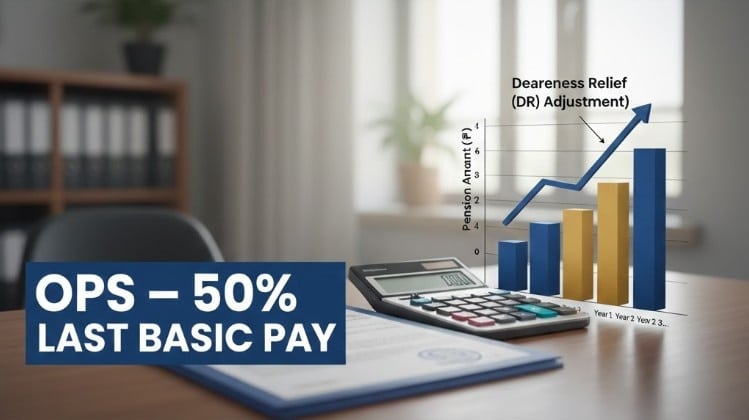
This amount increases regularly through Dearness Relief adjustments to match inflation.
Here is the IAS Pension Calculation Under Old Pension Scheme (OPS):
| Pay Level | Designation Example | Last Basic Salary (₹) | Monthly Pension @ 50% (₹) | With DR @ 53%* (₹) | Total Monthly Pension (₹) |
|---|---|---|---|---|---|
| Level 14 | Joint Secretary | 1,44,200 | 72,100 | 38,213 | 1,10,313 |
| Level 15 | Additional Secretary | 1,82,200 | 91,100 | 48,283 | 1,39,383 |
| Level 16 | Special Secretary | 2,05,400 | 1,02,700 | 54,431 | 1,57,131 |
| Level 17 | Secretary/Cabinet Secretary | 2,25,000 | 1,12,500 | 59,625 | 1,72,125 |
DR (Dearness Relief) rate as per the latest Department of Pension order rates revised periodically based on AICPI
Source: Pay scales as per 7th CPC Pay Matrix, Pension calculation as per CCS (Pension) Rules, 1972
Let’s take an Example ot understand this better: If your last salary was ₹2,25,000, you receive ₹1,12,500 as base pension, plus ₹59,625 as Dearness Relief, totaling ₹1,72,125 per month.
Additional Retirement Benefits
OPS members get Dearness Relief (DR) linked to AICPI, which adjusts every six months. Officers can exchange up to 40% of their pension for a one-time large payment as per Rule 5 of the CCS (Commutation of Pension) Rules, 1981.
Gratuity equals 16.5 times the last basic pay, with a maximum limit of ₹20 lakhs.
Leave encashment pays for unused leave days, and according to the rules for leave in government service, family pension provides dependents with 30% of the officer’s basic pay or 50% of the officer’s pension under Rule 54 of the CCS (Pension) Rules.
IAS Pension Under National Pension System (After 2004)
Officers who joined the IAS on or after January 1, 2004, entered a completely different system.
Instead of guaranteed benefits, their pension now depends on stock market returns. This change moved the risk from the government to the employee.
How NPS Works for IAS Officers?
The National Pension System requires 10% employee payment and 14% government payment as per the PFRDA notification.
At retirement, officers must use 40% of their total saved money to buy an annuity for monthly pension payments, while 60% can be taken out as a tax-free lump sum.

The monthly pension depends on annuity rates (usually 5-7% per year) and how well the stock market performed during their career.
Recent Update: Unified Pension Scheme (UPS) 2024
Launched August 24, 2024, UPS guarantees 50% of the average basic pay (last 12 months) for 25+ years of service. For shorter service (10-25 years), pension is proportionate: (Service Years ÷ 25) × 50% of salary.

Example: 15 years service = (15÷25) × 50% = 30% pension. An Additional Secretary earning ₹1,82,200 gets ₹54,660 monthly. Minimum pension: ₹10,000. Officers had until November 30, 2025, to switch from NPS to UPS.
How Much Pension Does An IAS Officer Get Per Month?
The monthly pension for an IAS officer changes greatly based on when they joined, what rank they retired at, and which scheme they’re under.
Officers under OPS get the highest guaranteed amounts, while NPS members face uncertainty, and the new UPS offers a middle option with assured benefits.
Here is the IAS Monthly Pension Comparison Across Different Schemes:
| Year of Joining | Pension Scheme | Pay Level at Retirement | Years of Service | Estimated Monthly Pension (₹) | Key Features |
|---|---|---|---|---|---|
| Before 2004 | OPS | Level 17 (Secretary) | 35 years | 1,72,125 (with DR) | 50% of last basic salary + DR; No employee contribution |
| After 2004 | NPS | Level 17 (Secretary) | 35 years | 85,000 – 1,20,000* | Depends on corpus accumulation & annuity rates; Market-linked |
| After 2004 (opted for UPS from April 2025) | UPS | Level 17 (Secretary) | 25+ years | 1,12,500 | 50% of average basic pay (last 12 months); Assured pension |
| After 2004 (opted for UPS from April 2025) | UPS | Level 15 (Addl. Secy) | 15 years | 54,660** | Proportionate pension for 10-25 years of service |
| After 2004 (opted for UPS from April 2025) | UPS | Any Level | 10 years | 10,000 (minimum) | Minimum guaranteed pension |
Formula for proportionate pension: If you work 15 years out of 25 needed: (15÷25) × 50% of average salary = 30% pension
For Example: Average salary ₹1,82,200 → 30% = ₹54,660/month (Formula as per UPS rules).
Important to know:
- DR (Dearness Relief) rates change every six months based on inflation.
- NPS returns depend completely on stock market performance and investment choices.
- DA (Dearness Allowance) during service is different from DR during retirement.
For the NPS pension, the amount you receive depends on three critical factors:
- The total money saved through your payments and government payments over your entire career (your total savings).
- The interest rate insurance companies offer when you retire (usually 5-7% per year) to convert your savings into a monthly pension.
- The type of pension plan you pick at retirement (options include life annuity, joint life with spouse, or annuity with return of purchase price).
Other Post-Retirement Benefits For IAS Officers
Beyond a pension, retired IAS officers get Central Government Health Scheme (CGHS) medical care as per CGHS regulations, giving continued healthcare at very low cost.
Many get appointments to advisory boards, commissions, and public sector companies based on their experience. Re-employment opportunities exist in legal bodies, regulatory authorities, and international organizations.
Some officers qualify for government housing for a limited time after retirement, depending on availability and specific rules.
IAS vs IPS vs IFS Pension Comparison
All India Services, including IAS, IPS (Indian Police Service), and IFS (Indian Foreign Service), follow the same pension rules as per AIS (Death-cum-Retirement Benefits) Rules, 1958.
The main difference is in pay scale changes at similar experience levels, which directly affect pension calculations since pension equals a percentage of basic salary.
An IAS Secretary at Level 17 gets the same pension formula as an IPS Director General or IFS Ambassador at the same pay level.
The rank reached at retirement matters more than the specific service, though career growth patterns differ across services, with IAS officers usually reaching higher administrative positions.
Conclusion: IAS Officers Get Pension Under OPS, NPS, Or UPS Schemes
IAS officers get pension benefits, with the system depending on when they joined. Officers joining before January 1, 2004, enjoy OPS with guaranteed, inflation-protected income, while those joining after faced market-linked NPS uncertainty.
The 2024 launch of the Unified Pension Scheme gives NPS members the option to switch to assured benefits from April 2025. Financial security remains strong across all schemes, though predictability varies.
For UPSC aspirants, understanding these pension structures helps in making informed career choices, as the IAS service now offers clearer retirement security than in recent years.
FAQs
IAS officers joining after January 1, 2004, receive pension through NPS (market-linked) or can opt for UPS (assured 50% of average pay) from April 2025.
Retired IAS officers at the Secretary level receive ₹1,72,125 monthly under OPS, ₹85,000-₹1,20,000 under NPS, or ₹1,12,500 assured under UPS, depending on their scheme.
Retired IAS officers may receive government accommodation temporarily based on their last posting, rank, availability, and current policy, though it’s not a guaranteed benefit.
IPS officers receive pension under identical rules as IAS officers (OPS, NPS, or UPS) since both fall under All India Services retirement benefit regulations.
OPS guarantees 50% of the last salary with no employee contribution and Dearness Relief, while NPS requires a 10% contribution and provides uncertain market-linked returns.