
Most UPSC students dream of becoming IAS officers, but IFS offers benefits that often go unnoticed. The real question isn’t about which service is superior. It’s about which one matches your personality and life goals.
I’ll break down both services in simple terms, and you’ll understand their work, pay, authority, and daily routines. By the end, you’ll have clarity on which service suits you best when filling out your DAF form.
IAS vs IFS: Overview
Both services attract India’s smartest minds, but they operate in totally different ways. Here’s a simple comparison of key factors:
| Aspect | IAS (Indian Administrative Service) | IFS (Indian Foreign Service) |
|---|---|---|
| Service Type | All India Service | Central Civil Service |
| Cadre Control | State Cadre + Central Deputation | Ministry of External Affairs (MEA) |
| Core Role | Administration, governance, policy implementation | Diplomacy, foreign policy, international relations |
| Training Institute | LBSNAA, Mussoorie | SSIFS (Sushma Swaraj Institute of Foreign Service), New Delhi |
| First Posting | Sub-Divisional Magistrate (SDM) | Third Secretary |
| Posting Location | Mostly within India | Mostly abroad |
| Transfer Frequency | High (domestic) | Moderate (long foreign tenures) |
| Public Interaction | Very high | Limited & formal |
| Decision-Making Power | High executive authority | Strategic & advisory influence |
| Starting Basic Pay | ₹56,100 (Level 10) | ₹56,100 (Level 10) |
| Allowances | DA, HRA/Govt housing, TA | DA + Foreign Allowance (abroad) |
| Lifestyle | High pressure, high visibility | Structured, global exposure |
| Work-Life Balance | Unpredictable | Relatively stable (except crises) |
| Spouse Career Impact | Lower | Higher (due to relocations) |
| Prestige Perception | Domestic authority & governance | International stature & diplomacy |
The real gap shows in total income, especially when IFS officers serve abroad. Their tax-free foreign allowances significantly boost monthly earnings compared to IAS officers stationed in India.
IAS Profile (Indian Administrative Service)
The work of an IAS Officer includes implementing government schemes, maintaining law and order, and managing district-level operations across India. An IAS officer holds high executive authority at district, state, and central positions.

They approve development projects, manage transfers, and make on-ground decisions affecting millions daily.
The typical career path progresses: SDM to ADM to DM to Divisional Commissioner to Principal Secretary to Chief Secretary to Cabinet Secretary, the highest bureaucratic position in India.
IFS Profile (Indian Foreign Service)
The IFS officer’s role centers on managing India’s relationships with other nations, negotiating international agreements, and representing the country at global forums like the UN, WTO, and G20.

Their power lies in strategic thinking and diplomacy rather than direct administrative control.
The career path advances: Third Secretary to Second Secretary to First Secretary to Counsellor to Minister to Ambassador or High Commissioner to Foreign Secretary, India’s chief diplomat.
IAS vs IFS Salary Structure (7th Pay Commission)
Both services begin at identical basic pay, but actual earnings vary widely based on posting location and additional allowances.
Here’s the complete picture:
| Pay Level | Basic Pay (Starting) | IAS Rank (State/Centre) | IFS Rank (at HQ/Delhi) | IFS Rank (Posted Abroad) |
|---|---|---|---|---|
| Level 10 | ₹56,100 | SDM / Under Secretary | Under Secretary | Third Secretary |
| Level 11 | ₹67,700 | ADM / Deputy Secretary | Under Secretary | Second Secretary |
| Level 12 | ₹78,800 | DM / Deputy Secretary | Deputy Secretary | First Secretary |
| Level 13 | ₹1,18,500 | DM / Director | Director | Counsellor |
| Level 14 | ₹1,44,200 | Div. Comm. / Joint Secy. | Joint Secretary | Minister |
| Level 15 | ₹1,82,200 | Principal Secy. / Addl. Secy. | Additional Secretary | Ambassador / High Comm. |
| Level 17 | ₹2,25,000 | Chief Secretary / Secretary | Foreign Secretary | Ambassador (Grade I) |
| Level 18 | ₹2,50,000 | Cabinet Secretary | N/A | N/A |
Source: IAS Pay Rules, 2016; Directory by MEA for Pay Scales & Levels; 7th Commission Notification
Gross Salary of an IFS officer abroad can be 3 to 4 times higher than an IAS officer’s earnings because of the Special Foreign Allowance (SFA). This allowance comes tax-free and in foreign currency.
An IFS officer posted in London or Washington DC receives upwards of ₹4 lakh monthly without any tax deductions.
Meanwhile, an IAS officer in India takes home roughly ₹1 lakh after all deductions. Although all IAS officers get a pension along with post-retirement perks like government housing and support staff.
IAS vs IFS Power and Authority
Powers of an IAS Officer translate into direct action. A District Magistrate can impose Section 144, sanction funds for roads or schools, transfer police personnel, and coordinate disaster response during emergencies.
In practical terms, an IAS officer’s word carries weight and gets things moving on the ground.
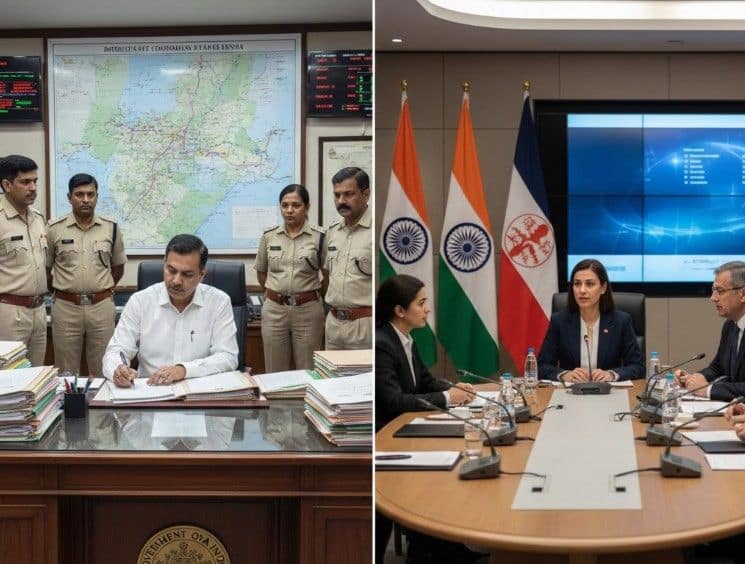
IFS officers exercise diplomatic and protocol-based influence. They negotiate trade agreements, brief senior leaders before international summits, and manage bilateral tensions with neighboring countries.
Their work in MEA roles includes handling sensitive desks like Pakistan relations, UN assignments, or economic diplomacy. They provide policy advisory functions but lack the enforcement authority that IAS officers command domestically.
IAS vs IFS Lifestyle and Work-Life Balance
IAS officers function within the state cadre framework, and frequent domestic transfers typically occur every two to three years. Families relocate from smaller towns to state capitals repeatedly.
Work-life balance becomes challenging during elections, natural calamities, or public disturbances. However, you remain connected to your home country and culture.

IFS officers enjoy long-term foreign postings spanning three to four years in a single location. This brings stability in global cities like Paris, Tokyo, or New York.
Yet foreign relocation brings career limitations abroad for spouses, particularly in nations with restrictive employment laws. Family separation occurs frequently when children attend boarding schools in India while parents serve overseas.
IAS vs IFS – Which Should You Choose?
Many OnlineIAS students wrestle with this decision during DAF preparation. Your answer depends entirely on the impact you wish to create and the lifestyle that appeals to you.
Choose IAS If
You feel drawn to grassroots governance and want visible results from your efforts.
If you’re willing to spend 6 to 8 hours navigating local politics and public demands, and you prefer public authority over behind-the-scenes diplomacy, IAS is your calling.
Officers like Smita Sabharwal and Ashok Khemka gained recognition through their bold administrative actions.
Choose IFS If
You crave international exposure and aspire to represent India globally. If diplomatic career goals appeal more, and you value structured overseas assignments over frequent transfers within India, IFS offers a unique trajectory.
Diplomats like Hardeep Singh Puri and Nirupama Rao influenced India’s foreign relations through decades of strategic negotiation.
Conclusion: IAS Offers Executive Authority In India; IFS Provides Diplomatic Influence Globally
IAS provides direct executive authority and tangible impact within India’s districts and states. IFS delivers global experience and substantially higher tax-free income during foreign assignments.
Your decision should reflect who you are. Both paths lead to fulfilling careers. But only one will align with your vision for the next three decades.
FAQs
Spouses face job difficulties abroad, families live apart for extended periods, and officers lack executive enforcement powers that their IAS counterparts possess. Assignments in challenging locations and restrictive visa regulations for dependents create practical obstacles.
IFS officers influence policy formation, negotiate international treaties, and counsel leadership on foreign affairs, but cannot issue executive orders or enforce regulations like IAS or IPS officers manage domestically.
Both begin at ₹56,100 (Level 10), but IFS officers abroad earn ₹3.5 to 4.5 lakh monthly tax-free, including Special Foreign Allowance. IAS officers receive approximately ₹1 lakh in India after standard deductions.
IAS offers maximum executive control, IFS provides international experience and higher foreign compensation, while IPS concentrates on law enforcement. Your better choice depends on preferring governance (IAS), diplomacy (IFS), or policing (IPS).
IAS suits aspirants seeking administrative authority in India and ground-level impact. IFS fits those desiring international careers and tax-exempt foreign earnings. Your personality type and career vision should guide this choice.