

The direct answer is no. An active IAS officer is generally prohibited from engaging in any private trade or business as per the official laws of India.
Transitioning from a successful civil service candidate to an established IAS officer entails significant authority, responsibility, and adherence to a strict code of conduct. One common question among aspirants concerns the involvement of active officials in private business: Is it possible for an IAS officer to engage in commercial activities while serving?
To provide a thorough, academic understanding of the limitations, exceptions, and ethical aspects that regulate the professional life of IAS officers, this article explores the legislative rules, particularly the All India Services (Conduct) Rules, 1968. The cornerstone of these rules is the preservation of complete impartiality and integrity.
The Legal Framework: All India Services (Conduct) Rules
The direct answer to the question of whether an active IAS official can participate in business is clearly no. To protect the fundamental tenets of government, the entire system of service norms is carefully crafted to separate public service from private financial benefit. You can read more about it here.
The Core Rule: Prohibition on Private Employment
The All India Services (Conduct) Rules, 1968, provide a detailed explanation of the precise rule governing this restriction. All members of the All India Services, including the IAS, are bound by these regulations as the official code of conduct.
Rule 13(1) of the rules mentioned earlier is the cornerstone of this restriction. It explicitly states that “No member of the Service shall, except with the previous sanction of the Central Government, engage himself in any trade or business or negotiate for, or undertake, any other employment.”
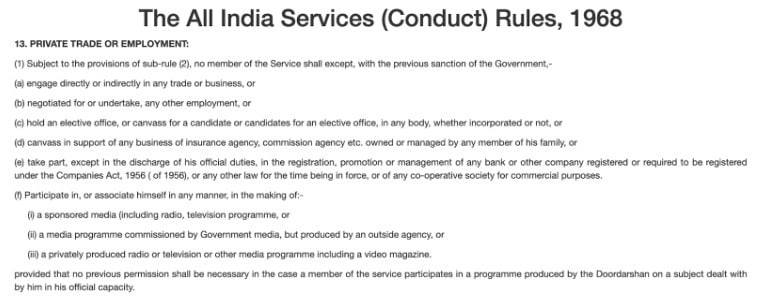
The All India Services (Conduct) Rules, 1968, provide a detailed explanation of the precise rule governing this restriction. All members of the All India Services, including the IAS, are bound by these regulations as the official code of conduct.
An active officer is not allowed to engage in any commerce or business, thereby creating a clear legal boundary. This broad prohibition covers both direct and indirect participation, such as using a proxy or serving as an active partner, as well as direct activity, such as personally starting a business. The fundamental principle is that an officer’s full potential and dedication must be devoted solely to their official responsibilities.
Reasons For The Restriction: Upholding Integrity
The ban on corporate involvement is more than just an administrative regulation; it is a vital tool designed to safeguard India’s core values of good governance and public confidence. These limitations guarantee the unbiased and moral functioning of the government’s machinery.
Prevention Of Conflict Of Interest (The Primary Concern)
When an officer’s personal financial interest may hinder the impartial performance of their official duties, a conflict of interest occurs. The public good and the unbiased application of policy are the officer’s primary responsibilities.
Private business interests should never be permitted to conflict with or take precedence over this public duty, particularly in order to avoid the possibility of favouritism, bias, or the abuse of the official position for personal or commercial gain.
Maintenance of Impartiality and Integrity
Serving the government, especially in the All India Services, demands the highest ethical standards and complete integrity, and the public’s perception of these services must not be tarnished.
The officer would be unavoidably subject to competitive market dynamics if they engaged in commerce or business, which may threaten their administrative and judicial neutrality when handling issues related to their own or rival businesses, thereby eroding public faith.

Demands of Public Duty (Time Commitment)
The IAS position is famously demanding; it often requires long hours, extensive travel, and a commitment to pressing public concerns such as policy implementation or disaster management.
Given the wide range of roles and responsibilities, effective governance requires the officer’s full-time attention. Running a private business, which also demands significant managerial oversight, would inevitably compromise the time and focus required for official duties.
Curbing Corruption
The need to reduce corruption is a major motivator for the restrictions, since the interaction between private financial interests and government regulatory authority creates a high-risk environment for malpractice.
The regulations greatly reduce the ability and motive to engage in corrupt actions, such as bribery or preferential policy drafting, for direct personal economic profit by legally distancing the official from private remunerative business.
Exceptions and Permitted Financial Activities
The All India Services (Conduct) Rules respect the officer’s right to personal financial planning and family life, permitting some activities under strict conditions of transparency and non-interference, even if they strictly forbid commercial activity.
Purely passive financial investments, such as owning stocks, bonds, mutual funds, and other financial instruments, are allowed for an IAS officer.
The important condition is that these must be completely hands-off; the official is not permitted to participate in speculative trades or actively manage or supervise the firm or business in which they own shares. Making this separation is essential to keeping the officer’s personal financial management separate from their official responsibilities.

Additionally, the regulations allow a spouse or other dependent family member to pursue a career or business. In certain situations, an IAS officer is required to inform the government about a family member’s business.
This declaration serves as a procedural precaution to prevent the family company from creating an actual or perceived conflict of interest with the officer’s official administrative duties, especially when the business interacts with the officer’s department.
Officers are rarely allowed to engage in non-official activities. When they do, it’s usually limited to unpaid, literary, creative, or scientific endeavours that don’t conflict with their difficult public obligations.
The compensation structure of an IAS officer reflects the level of responsibility and public accountability attached to the role. Details about how IAS officers are paid and the benefits they receive can help aspirants better understand the financial aspects of the service.
Post-Service Opportunities: The Entrepreneurial Path
A person is only subject to the rigorous limitations on commercial participation while they are an active IAS officer. The legal environment shifts significantly when an officer officially leaves the Service, whether by resignation or superannuation, creating opportunities for entrepreneurship.
Post-Resignation
At any stage of their career, an IAS officer has the last option to resign from the Service in order to pursue work in the private sector. By taking this action, the limitations of the All India Services (Conduct) Rules, 1968, are instantly lifted.
Information on service tenure and exit rules, including the retirement age for IAS officers, helps clarify how officers can formally transition out of government service. Many successful entrepreneurs who were previously IAS officers have chosen this route, completing the required formalities and redirecting their administrative expertise toward building their own ventures.
Post-Retirement
IAS officers are legally permitted to launch and run any business they choose after superannuation or retirement, without government permission.
Retired officers frequently leverage their decades of experience in public policy, governance, and regulatory frameworks by starting consulting firms or participating in a variety of social and commercial enterprises.
Conclusion: Integrity Is Non-Negotiable For Public Service
In order to avoid basic conflicts of interest and preserve complete administrative neutrality, the law prohibits an active IAS official from engaging in commerce or business. The officer’s commitment must be unwavering, even though family businesses and passive financial investments are allowed (with transparency).
Integrity is non-negotiable for success in the UPSC journey and beyond, and rigorous adherence to the All India Services (Conduct) Rules, 1968, is crucial for maintaining public faith.
FAQs
Yes, an IAS officer can invest in shares, mutual funds, and other financial instruments. These investments must be passive, meaning the officer cannot be involved in the management or direction of the companies in which they hold shares.
No. Rule 13(1) of the Conduct Rules prohibits engaging in business either directly or indirectly. Even a silent partnership implies indirect involvement and financial interest, constituting a violation without explicit, rare government sanction.
Yes, the spouse can start a business. However, the IAS officer must report this business to the government to ensure there is no actual or perceived conflict of interest with the officer’s current official duties.
Upon superannuation or resignation, an IAS officer is legally free from the Conduct Rules and can start any business. However, certain high-level retirees may face a “cooling-off period” before accepting private employment.