If you aspire to be an IAS officer one day, you need to know the real-world duties of an IAS officer!
An IAS is more than just a fancy designation. The title means taking on significant jobs in administration, development, and keeping the peace. The work takes place right from your locality all the way up to Delhi.
In this article, I’m going to tell you all about the duties of an IAS officer. We’ll explore the different roles they take on and what they consist of, from entry-level to the very top post.
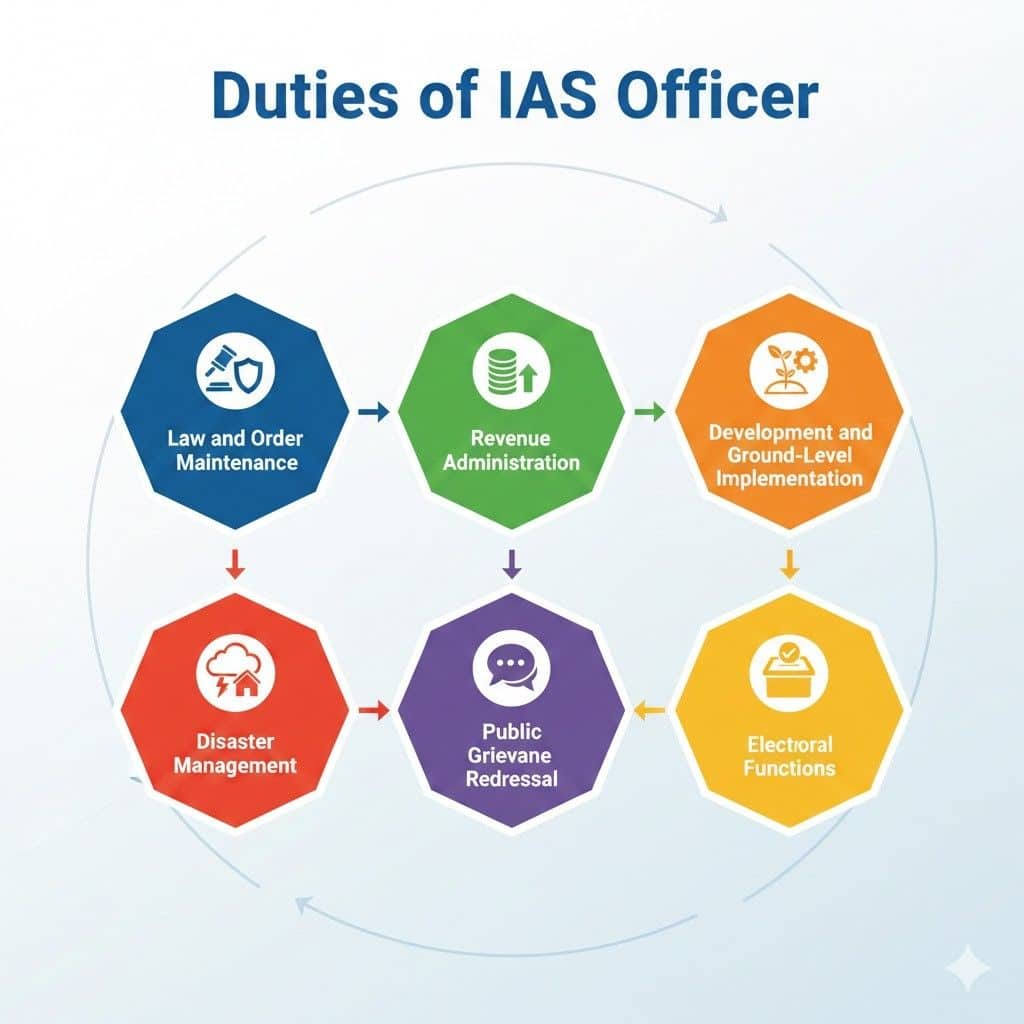
The Executive Pillar: IAS As The Field Commander
This phase of the career is the most visible and difficult. This is when they implement the policies on the ground, addressing emergencies daily.
A. The Role of District Magistrate (DM) / District Collector
The District Magistrate (DM) or District Collector (DC) is the head executive. They are responsible for the management of the entire district. They also have control of the executive functions in the field.
1. Law and Order Maintenance (The Executive Magistrate)
The DM serves as the Senior-most Executive Magistrate under the Code of Criminal Procedure (CrPC), making them the main official responsible for public safety. This role involves working closely with the Superintendent of Police (SP) to manage the police force, control public order, and ensure peace, especially during crises or protests.
Furthermore, the DM has the legal authority to issue major orders, such as imposing curfews or invoking Section 144 to prevent large gatherings.
For instance, the DM frequently uses Section 144 CrPC to impose movement restrictions and uphold order during tense communal situations or widespread student agitations.
2. Revenue Administration (The Collector)
The Collector acts as the Chief Manager of Government Land, overseeing all land-related issues like collecting taxes and maintaining records. This includes managing the complex process of Land Acquisition for public projects, ensuring fair compensation.
Additionally, the Collector functions as the Highest Revenue Court for all land and property disputes at the district level.
A common example is the Land Acquisition for major national projects, such as the construction of an Expressway or a new airport.
The Collector must properly manage this process and ensure that the affected farmers receive fair compensation and relocation, such as in projects like the Yamuna Expressway.
B. Development and Ground-Level Implementation
This is the side of the IAS that ensures government benefits and services reach everyone, even in the most remote areas.
1. Policy Translation
Here, the core duty is to take broad state and central government policies. They then change these policies (for health, education, or money) into specific, practical local programs. These programs must fit the unique needs of the district.
2. Chief Development Officer (CDO)
The CDO officer watches over and monitors all major government development projects. This includes big national schemes like the Mahatma Gandhi National Rural Employment Guarantee Act (MGNREGA) and Pradhan Mantri Awas Yojana (PMAY). They ensure public money is used well and project goals are met on time.
An IAS officer might, for instance, use the money from the MGNREGA scheme to restore hundreds of defunct water bodies (such as the Jaladharini Dooars initiative) in a district that is water-stressed rather than just building new roads.
3. Supervisory Role
The IAS officer is the chief quality checker. They carry out surprise checks on important government services and buildings. This includes schools, health centers, ration shops, and offices. The checks ensure good service, efficiency, and help stop corruption.
Crisis Management and Public Accountability
When a disaster strikes, the IAS officer is the government’s official face on the ground. They immediately take full charge of rescue operations, coordinating all agencies for relief and recovery efforts.
1. Disaster Management
The officer is in charge of the District Disaster Management Authority (DDMA). The officer serves as the overall head during natural disasters (initiating flood situations, cycles, and outbreaks).
A notable case is the disaster response in Odisha, where senior IAS officers oversaw the state’s shift from high casualties to almost zero deaths during subsequent cyclones. They did this by putting strong Standard Operating Procedures (SOPs) into place.
2. Public Grievance Redressal
A key responsibility is being the direct contact for citizens’ complaints through public hearings (‘Janta Darbar’) and online tools. The officer must quickly address issues, be fully transparent, and act as a fair, neutral judge between the government and the citizen.
For example, implementing digital platforms like the Dharani Portal (Telangana) for land records allows citizens to quickly check ownership details and file complaints. This will promote transparency and resolve disputes much faster.
3. Electoral Functions
The IAS officer is the District Electoral Officer (DEO), as required by the Election Commission of India (ECI). Their job is to manage the entire process of state and national elections in the district, making sure they are free, fair, and clear.
The Policy Pillar: Roles In The Secretariat
After gaining practical experience in the field, officers move to the Secretariat. Here, they switch their focus from hands-on work to creating and shaping high-level policy.
A. State Government Postings (Secretary / Principal Secretary)
Under state government postings, officers function as the administrative head of their department.
1. Advisory Role
Officers give senior administrative, technical, and experienced advice to the state’s elected Ministers about their department’s issues (like health or finance).
For example, an officer posted as the Principal Secretary (Health) advises the Health Minister on how to allocate the budget to build new hospitals.
2. Legislation and Rule-Making
They are responsible for writing the detailed rules, regulations, and official orders needed to properly put new or changed laws into effect.
3. Budgetary Control
They manage the entire annual budget for their department, approving major expenses and making sure all spending is careful and follows the rules.
4. Inter-Departmental Coordination
A vital role is fixing disagreements and ensuring smooth, synchronized work between various state departments so the government works well as one unit.
B. Central Government Postings (Joint Secretary / Secretary)
Under central government postings, officers shape national strategy and represent the country globally.
1. National Policy Formulation
At the Union Government level, officers help write and improve major national policies that affect the whole country, such as the National Education Policy or rules for international trade.
For example, a Joint Secretary in the Ministry of Education would play a key role in writing the guidelines for rolling out a new curriculum framework across the country.
2. International Representation
They often represent India in global meetings, talks, and world organizations (like the United Nations or WTO), handling important international and trade matters.
3. Leadership of PSUs
Senior IAS officers often get top management positions (like Chairman or Managing Director) in various Government-owned Public Sector Undertakings (PSUs).
Career Progression: From SDM To Apex Bureaucrat
Up until now, we have already covered the ground-level work and high-level policy duties of an IAS officer. Now, we’ll be looking at a clear career path of an IAS officer, from first posting up to the very top positions.
1. Sub-Divisional Magistrate (SDM)
This is the first field job, typically managing revenue and law enforcement for a sub-division (Level 10). They are the initial face of the administration, directly dealing with local issues and public grievances.
2. District Magistrate (DM)
Head of the District, holding dual powers over law/order and revenue administration (Level 12 to 14). They coordinate all government agencies in the district and lead crisis management efforts.
3. Divisional Commissioner / Secretary (State)
Regional supervisor for several districts or the administrative head of a key State Department (Level 14 to 15). They manage large budgets and ensure state policies are smoothly executed across the region.
4. Secretary / Additional Secretary (Central)
These are top policy-making roles in Central Ministries (Level 16 to 17). They prepare briefs for Ministers and contribute to formulating major national laws and policies for the Union Government.
5. Chief Secretary
The highest IAS post within any State administration (Apex Scale, Level 17). This officer acts as the principal advisor to the Chief Minister, overseeing the entire state bureaucracy and administration.
6. Cabinet Secretary
The single highest civil service position in India (Cabinet Secretary Grade, Level 18). This officer heads the Civil Services, advises the Prime Minister, and coordinates the work of all Central Ministries.
Related Reads:
Take Your First Step Towards IAS Today!
The IAS is the backbone of governance, from the ground level through the District Administrator and at the highest level through the Policy Secretariat. An IAS officer experiences the entire spectrum of responsibility. This includes running development programs and coaching the Union Ministers.
If you’re hoping to take on one of these roles one day, understanding the duties that come with them is important. Start preparing for your IAS journey today!
FAQs
Officers receive basic pay (₹56,100 starting), DA, HRA, a subsidized house, an official vehicle, and full medical coverage.
Posting to the home state is rare. Allocation depends on a very high UPSC rank due to the ‘outsider’ posting rule.
The DM is the Executive Magistrate who coordinates with the SP and issues mandatory public order enforcement.
The IAS holds higher executive power in policy, finance, and general administration. Both roles are vital and distinct.
The IAS is a demanding, 24/7 career. Officers must be available constantly, especially during field postings and crises.