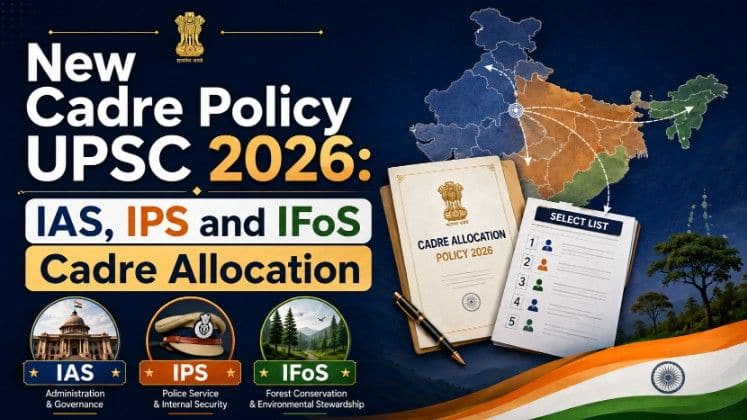
The Government of India announced a New Cadre Allocation Policy for All India Services in January 2026. This policy deals with the IAS, the IPS, and the IFoS.
It comes into effect from the Civil Services Examination 2026 and the Indian Forest Service Examination 2026. The policy framework has been put forth by the Department of Personnel and Training on 23 January 2026.
The key modification is quite easy to understand. The previous classification into five zones, which had been introduced in 2017, no longer exists.
Instead, there is a new classification based on four groups. All 25 state and joint cadres fall within one of the four alphabetical groups every year.
What Is Cadre Allocation?
The process of cadre allocation comes into play after the UPSC declares the final result of the Civil Services Examination.
It decides on the state or joint cadre that the candidate who has been selected will have to join. A person normally remains in that cadre for the whole of his/her career.
The term ‘cadre’ refers to the unit of administration under which the IAS, IPS, or IFoS officers work. It may either be one single large state or a combination of many small states and union territories together called AGMUT.
Why did the Government Introduce A New Policy?
The zonal system of 2017 operated for nearly a decade. In this period, certain issues emerged.
- Some popular cadres continued to draw most of the top-ranked candidates, while some states struggled with officer shortages.
- The sequence of zones followed by the cadre application process was lengthy and complicated for candidates applying through these forms.
- There was ambiguity in terms of the eligibility criteria for EWS, PwBD, and the category-wise exchange that resulted in lawsuits.
The policy of 2026 addresses each of these issues. This policy adopts a definite and pre-decided sequence based on certain rules. The objective is described as transparency, fairness, national integration, social justice, and reduction in litigation.
The Four New Cadre Groups
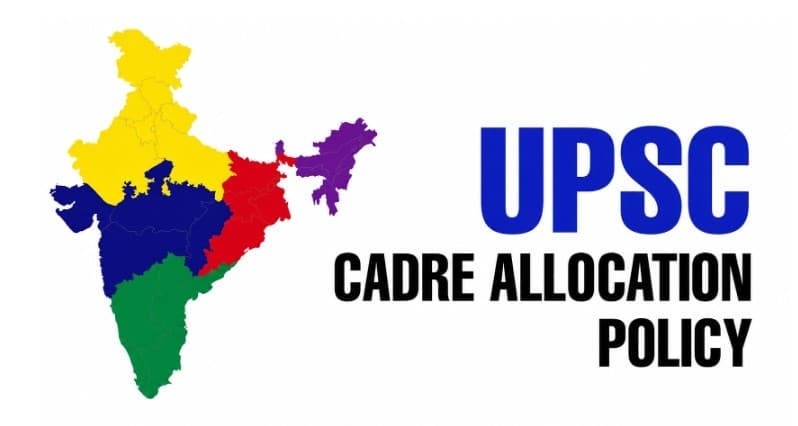
The system of 2017 involved five geographical zones. However, in 2026, there is no zoning at all, but four categories are formed on an alphabetical basis of 25 cadres.
| Group | Cadres Included |
|---|---|
| Group I | AGMUT, Andhra Pradesh, Assam-Meghalaya, Bihar, Chhattisgarh |
| Group II | Gujarat, Haryana, Himachal Pradesh, Jharkhand, Karnataka, Kerala, Madhya Pradesh |
| Group III | Maharashtra, Manipur, Nagaland, Odisha, Punjab, Rajasthan, Sikkim, Tamil Nadu |
| Group IV | Telangana, Tripura, Uttarakhand, Uttar Pradesh, West Bengal |
Cadre group membership is not permanent. Group rotation occurs yearly and will be discussed further in the following section.
How Does Annual Group Rotation Work?
Group rotation stops any one state from being permanently ahead of or behind the others in the queue for outsiders’ allocations.
- Group I of the previous year’s allocation cycle gets relegated to the bottom position in the cycle.
- The next year’s allocation cycle begins with Group II.
- This process continues in order, such that each group gets to be at the head of the queue.
In a few years, the process of rotation ensures that outsiders’ officers, regardless of rank and category, get distributed among all four groups.
2017 Zonal System vs 2026 Group System
The comparison of key changes between the 2017 Zonal System and the 2026 Group System is as follows:
| Feature | CAP 2017 (Old) | CAP 2026 (New) |
|---|---|---|
| Basic unit | Five geography-based zones | Four alphabetical groups |
| Preference filling | Rank zones, then cadres within zones | Simpler, more direct cadre preference list |
| Rotation | No structured annual rotation | Groups rotate every year |
| EWS treatment | Handled separately in practice | Folded into UR vacancies explicitly |
| Category exchange | Less standardised | Fixed exchange sequence for UR, OBC, SC, ST |
Insider Allocation: The Home Cadre Rule
The process of insider allocation provides the candidate with the cadre belonging to the declared home state of the candidate, provided that rank and vacancy are available.
1. Individual merit lists are prepared for UR, OBC, SC, and ST candidates.
2. The allocation is done in a cyclic manner, such as from ranks 1 to 25, then from 26 to 50, and so on.
3. A reserved candidate clearing through general merit may still opt for an insider UR seat based on rank.
4. In case of a tie within any particular cycle, the person with lower rank gets shifted to the next cycle.
This cyclic process is adopted to replace the discretionary system followed earlier.
Category Exchange for Unfilled Insider Vacancies
If an insider vacancy in one category cannot be filled from within that category, the policy defines a fixed exchange order.
| Vacancy Type | Exchange Order |
|---|---|
| UR | Insider ST, then insider SC, then insider OBC |
| OBC | Insider ST, then SC, then UR |
| SC | Insider ST, then OBC, then UR |
| ST | Insider SC, then OBC, then UR |
PwBD candidates get priority within these exchanges. The insider vacancies that remain vacant at the end of the process become outsider vacancies for the current year of examination. They do not carry forward to the next year of examination.
Outsider Allocation and the Roster System
Outsider allocation involves placing a person outside his home cadre after all insider seats have been allocated.
- Preference for PwBD candidates not getting seats in their home cadres comes first in outsider allocation, and only one such candidate gets preference in outsider allocation with respect to a non-home cadre.
- The seats which remain are allocated following a roster procedure, where the first round begins with Group I cadres and then proceeds to Group II, III and IV cadres.
- In case of an error where a person ends up getting a seat in his home cadre through outsider allocation, this seat is exchanged with the next person in rank.
EWS and PwBD Provisions
The EWS vacancies belong to the Unreserved list and not to a separate stream. The EWS category members get to compete for the UR list openings.
The PwBD category gets preference in various processes such as category transfer and outside reservation, and even the supernumerary position if there is no vacancy in the chosen cadre.
When do IAS/IPS/IFoS allocations happen?
The state government is required to submit vacancy details by 31st January every year.
All vacancies decided upon will be put into publication before the announcement of the final examination result.

Allocation of IAS cadre is meant to be done before the commencement of the foundation course at LBSNAA (Lal Bahadur Shastri National Academy of Administration).
After the appointments of the IPS/IFoS cadre, allocation of cadres follows immediately thereafter.
Those who were allocated cadres according to the 2017 guidelines and others awaiting cadre allocation under previous exams are not part of this policy.
Conclusion: What this Means For CSE 2026 Aspirants
The 2026 policy thus makes cadre allocation a predetermined process in line with a fixed order. Rank and category now decide almost every outcome, with very little room left for discretion or last-minute negotiation.
For a CSE 2026 candidate, the practical takeaway is straightforward. Preparation and rank matter more than trying to predict or influence which cadre group comes out on top in a given year.
Since each state cadre has its moment to be allocated first, no state will be favored or discriminated against in the long run.
This new policy once again reveals a trend inside the UPSC system: fewer discretionary decisions and greater orientation towards national integration rather than regionalism among officers.
FAQs
The biggest change is the move from five zones to four alphabetical groups, with those groups rotating each year.
Insider allocation places an officer in their declared home state cadre. Outsider allocation places an officer in any other cadre through the roster system.
EWS vacancies are counted as part of the Unreserved quota rather than as a separate reserved category.
No. It applies only from CSE 2026 and IFoS 2026 onwards. Earlier batches remain under the 2017 rules.
A candidate can attempt one improvement attempt in the following year’s exam using a training exemption, but only before resigning from service.