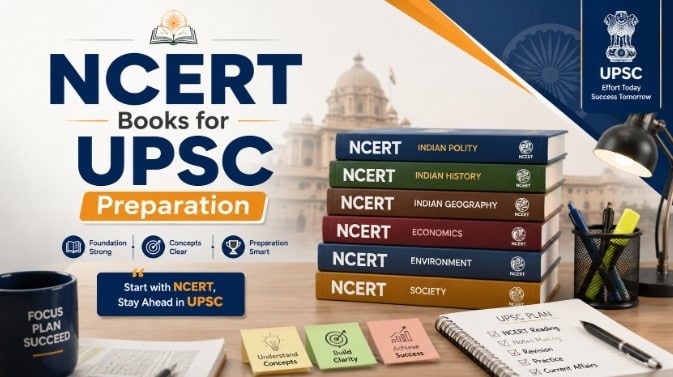
UPSC Civil Services examination preparation begins with NCERT books since they cover the concepts of everything in all subjects under General Studies.
Almost all toppers in UPSC have suggested NCERT books as a first step, as they are user-friendly and written in simple language.
Moreover, they are completely connected to the UPSC syllabus and do not contain any unnecessary details, so that one can make concepts before going for reference books.
NCERT books are considered safest for any fresher starting with this exam.
Complete Subject-Wise NCERT Books For UPSC Preparation
The following table shows the list of core NCERT books which candidates require for the GS Prelims and GS Mains examinations.
| Subject | Class | Importance | Read Priority | |
|---|---|---|---|---|
| Ancient India | XII | Themes in Indian History – Part I | High | Must Read |
| Medieval India | XII | Themes in Indian History – Part II | High | Must Read |
| Modern India | XII | Themes in Indian History – Part III | Very High | Must Read |
| Art & Culture | XI | An Introduction to Indian Art | Medium | Recommended |
| Physical Geography | XI | Fundamentals of Physical Geography | Very High | Must Read |
| Indian Geography | XI | India: Physical Environment | Very High | Must Read |
| Human Geography | XII | Fundamentals of Human Geography | High | Must Read |
| Indian Constitution | XI | Indian Constitution at Work | Very High | Must Read |
| Polity Concepts | IX–X | Democratic Politics I & II | Medium | Recommended |
| Indian Economy | XI | Indian Economic Development | Very High | Must Read |
| Economics Basics | XII | Introductory Microeconomics | Medium | Optional |
| Science (Physics basics) | VI–X | Science | Medium | Skim Quickly |
| Science (Biology basics) | VI–X | Science | Medium | Skim Quickly |
| Environment & Ecology | XII | Biology (Ecology chapters) | High | Must Read |
| Indian Society | XII | Indian Society | Medium | Recommended |
| Social Change | XII | Social Change and Development in India | Medium | Recommended |
History NCERT Books For UPSC
History is one of those topics that give maximum marks in both Prelims and Mains exams, covering Ancient, Medieval, Modern History of India and Struggle for Freedom.
Toppers make chapter-wise notes and revise using a timeline and map chapters to previous-year questions.
Here are the History NCERT Books for UPSC preparation:
- NCERT Class VI – Our Past – I
- NCERT Class VII – Our Past – II
- NCERT Class VIII – Our Past III
- NCERT Class IX – India and the Contemporary World – I
- NCERT Class X – India and the Contemporary World – II
- NCERT Class XI – Themes in World History
- NCERT Class XII – Themes in Indian History – I, II, III
- Old NCERTs: Ancient India (R.S. Sharma), Medieval India (Satish Chandra), Modern India (Bipan Chandra)
Geography NCERT Books for UPSC
Geography combines geographical knowledge with contemporary issues such as climate and resources, making it a common Prelims subject.
Top performers study through NCERT along with an atlas, utilizing maps and diagrams instead of textual notes.
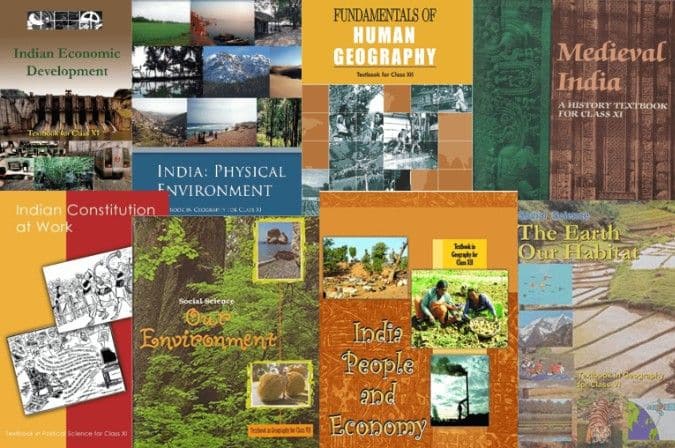
Here are the Geography NCERT Books for UPSC preparation:
- NCERT Class VI – The Earth: Our Habitat
- NCERT Class VII – Our Environment
- NCERT Class VIII – Resources and Development
- NCERT Class IX – Contemporary India – I
- NCERT Class X – Contemporary India – II
- NCERT Class XI – Fundamentals of Physical Geography
- NCERT Class XI – India: Physical Environment
- NCERT Class XII – Fundamentals of Human Geography
- NCERT Class XII – India: People and Economy
Polity (Political Science) NCERT Books for UPSC
Polity is undoubtedly one of the most predictable and scoring subjects, involving both constitution-related information in Prelims as well as governance in Mains.
Toppers maintain article-by-article notes and keep updated on judicial pronouncements and amendments along with the main textbook.
Here are the Polity NCERT books for UPSC preparation:
- NCERT Class IX – Democratic Politics – Part I
- NCERT Class X – Democratic Politics – Part II
- NCERT Class XI – Indian Constitution at Work
- NCERT Class XI – Political Theory
- NCERT Class XII – Contemporary World Politics
- NCERT Class XII – Politics in India Since Independence
Economics NCERT Books for UPSC
As Economics involves both concepts and contemporary statistics such as the Budget and Economic Survey, the UPSC makes Economics and Current Affairs go hand in hand.
Toppers connect chapters from books with contemporary developments rather than old statistics.
Here are the Economics NCERT books for UPSC preparation:
- NCERT Class IX – Economics
- NCERT Class X – Understanding Economic Development
- NCERT Class XI – Indian Economic Development
- NCERT Class XII – Introductory Microeconomics
- NCERT Class XII – Introductory Macroeconomics
Science NCERT Books for UPSC
UPSC science questions are based on applications and not on technical knowledge. Thus, science is a subject that does not require extensive reading, just selective reading.
Top students study it once and revise it via current affairs related to health, space, and technology.
Here are the Science NCERT books for UPSC preparation:
- NCERT Science textbooks for Classes VI to X
- NCERT Class XI – Chemistry (Unit 14: Environmental Chemistry)
- NCERT Class XI – Biology (Units 4 & 5)
- NCERT Class XII – Chemistry (Unit 16: Chemistry in Everyday Life)
- NCERT Class XII – Biology (Units 8, 9 & 10)
Environment and Ecology NCERT Books for UPSC
Environment has been one of the top-scoring sections in the Prelim examinations in recent times, which deals with biodiversity, ecosystems, and conservation policies.
Toppers use the NCERT chapter in conjunction with current environmental sources.
Here are the Environment and Ecology NCERT books for UPSC preparation:
- NCERT Class VII – Our Environment
- NCERT Class XII – Biology (Chapters 11 to 14)
- NCERT Class XI – Biology (selected chapters on environment)
Society, Art and Culture NCERT Books for UPSC
Questions on society and culture test your societal understanding and knowledge of the heritage of India. Toppers use the content of this chapter as concept-building rather than memorising it.
Here are the Society, Art and Culture NCERT books for UPSC preparation:
- NCERT Class XI – An Introduction to Indian Art
- NCERT Class XII – Living Craft Traditions of India (selected chapters)
- NCERT Class VI – Social Science: Social & Political Life I
- NCERT Class VII – Social Science: Social & Political Life II
- NCERT Class VIII – Social Science: Social & Political Life III
- NCERT Class XI – Sociology: Understanding Society
- NCERT Class XII – Indian Society
- NCERT Class XII – Social Change and Development in India
Where to Get NCERT Books?
Free NCERT textbooks can be downloaded as PDFs on the official website of NCERT (ncert.nic.in). These books are available in physical format as well at very low prices at the official sales counters of NCERT, authorized bookstores, and various other online retail websites.
1. Free Digital Downloads (Fastest & Cheapest)
Official Website: You can download either entire books or individual chapters at once through the NCERT Textbooks portal.
Mobile Apps: All your requirements for studying are available at your fingertips through the NCERT Books app available on the Google Play Store.
2. Purchase Physical Copies
Local Bookstores: You can visit any local book depots such as Vidyarthi Book Depot, Navneet Prakashan, etc., where you will find standard NCERT books easily.
E-Commerce: You can easily purchase standard sets from Amazon India and various other e-commerce websites.
Second-hand: You can save your money by buying second-hand books from websites such as MyPustak.
3. Order Directly from NCERT
NCERT Postal Books: You can make bulk orders or purchase textbook sets through the official NCERT Postal Books portal.
Best Reading Order for NCERT Books
Following the right order in reading NCERT books avoids any kind of confusion and ensures a stepwise development of knowledge.
Phase 1: Foundation
Start with reading the textbooks from Classes 6 to 8 in the subjects of History, Geography, and Civics. It helps develop vocabulary and context without overburdening the learner with too much information.
Phase 2: Intermediate
Read the books of Class 9 and Class 10 for concepts in Polity, Economics, and Science. The intermediate level aims at building on the fundamental stage before going ahead to the advanced topics.
Phase 3: Advanced
Conclude your syllabus with the books of Classes 11 and 12, which have the most UPSC importance. This phase should involve detailed notes, revision, and PYQ mapping.
Which NCERT Editions Should UPSC Aspirants Read?
The following are the NCERT editions that are important for Aspirants to read:
Old NCERT
Old NCERTs, authored by scholars such as R.S. Sharma and Satish Chandra, are characterized by a fact-filled and descriptive explanation style.
The old editions give a more chronologically detailed account of the events. Most UPSC reference books for preparing the syllabus are derived from the old NCERTs.
Old NCERTs still retain high relevance for History due to their emphasis on analytical depth rather than simplification.
New NCERT
The new NCERTs, issued post NCF revision, adopt a more simplified storytelling approach with improved illustration.
The new editions are easy to comprehend but lack the in-depth analysis required by some topics of the UPSC syllabus. New NCERTs are ideal for subjects such as Polity, Geography and Environment, which require knowledge of the latest laws, data and information.
Recent editions of NCERTs also have a rationalized syllabus with many older chapters being stripped off.
What to Read After NCERT Books?
NCERT books build the basic foundation, but UPSC Mains needs more in-depth analysis and up-to-date information, which can only be provided by better books.
| Subject | NCERT | Advanced Book |
|---|---|---|
| Polity | Indian Constitution at Work | Indian Polity by M. Laxmikanth |
| Economy | Indian Economic Development | Indian Economy by Ramesh Singh |
| History | Themes in Indian History I–III | India’s Struggle for Independence / Spectrum |
| Geography | Fundamentals of Physical Geography | Certificate Physical and Human Geography by G.C. Leong |
| Environment | Biology (Ecology chapters) | Environment by Shankar IAS |
| Art & Culture | An Introduction to Indian Art | Indian Art and Culture by Nitin Singhania |
It is recommended to start advanced books only after completing the concerned NCERT books along with revising them at least once.
One should not directly move to the advanced books without an understanding of NCERT books, as they presuppose some concepts.
How NCERT Books Help in Prelims and Mains?
The utility of NCERT books is maximum in the case of Prelims, wherein they can cover around 60-70% of the syllabus; however, candidates will need conventional reference books like Laxmikanth for Indian Polity and Ramesh Singh for Indian Economy for the remaining.
In the case of Mains, NCERTs act more as a base rather than being used for full-fledged answer writing. In the words of one of the study guides, “NCERTS are just that, and Mains demands a lot more than this.” Anantam IAS
There are particular NCERTs which have been prescribed for particular GS Papers. E.g., the NCERT book on Economics, Classes 9-12, covers concepts like sectors of the economy, national income, economic reforms, etc., which are part of GS Paper 3 (Indian Economy & Economic Reforms).
Conclusion: Build Strong Fundamentals Before Advanced Preparation
A well-thought-out strategy that relies on NCERT textbooks allows IAS candidates to have the required conceptual understanding to crack both prelims and mains.
Revision is the process that converts mere reading of NCERT into exam-preparedness.
Moving from NCERT to advanced textbooks must be done only after one finishes reading NCERTs and revises them at least once.
Actionable Takeaway: Start with Class 11 and 12 NCERTs of your worst subject starting this week and complement reading of each chapter with no less than five-year-old PYQs before moving to advanced textbooks.
FAQs
You just need to study the books for Classes 9-12 in History, Geography, Polity, Economy, Science, and some Art & Culture books.In terms of preparing for the UPSC exams, there is no need to go through all NCERT books.
For beginners, the new NCERT textbooks from classes 6 to 10 for subjects such as History, Geography, Polity, and Economics are the best place to begin. The books introduce basic concepts through simple language, interesting narratives, and relatable illustrations and examples before moving on to advanced textbooks.
Yes, free PDFs of NCERT books are available. One can get chapter-wise or complete PDFs for classes from 1 to 12 at no cost at all via the official NCERT Textbook PDF site. These are also available for free on official sites such as the DIKSHA Platform and the ePathshala mobile app.
NCERT books of Class 6 to Class 12 form the essential part of UPSC exam preparation. While Classes 6 to 10 lay the base. Classes 11 and 12 become extremely significant in terms of syllabus because they help in understanding the advanced concepts required for the Prelims and Mains exams.
Yes, you should go through Old NCERT books if you are appearing in the UPSC/IAS exam or any state PSC examination. These books are an excellent source of highly factual and chronological basic information, particularly in History and Geography subjects.