

The IAS has wider control over government work, while the IPS has direct power over the police force. In India’s civil services, “power” means different things for different jobs.
An IAS officer manages entire districts, handles money matters, and runs all government departments. An IPS officer controls the police, keeps law and order, and handles security issues.
This article explains their different powers, career paths, and how they work together in India’s government system, helping you understand what each service really controls.
TL;DR: IAS vs IPS Power Comparison
- IAS runs policy and government work across all departments in a district or state.
- IPS controls police operations, manages security, and enforces laws on the ground.
- At the district level: District Magistrate (IAS) oversees everything; Superintendent of Police (IPS) handles policing.
- Real power depends on your job posting, a DM in a tough district or an IG leading anti-terror units both hold serious authority.
- Career peak differs: IAS reaches Cabinet Secretary (top government post), IPS reaches Director General of Police.
IAS Power and Authority (Indian Administrative Service)
An IAS officer runs government administration and puts policies into action across different departments. Duties of an IAS officer include starting government programs, collecting revenue, and managing development projects.
- District Magistrate (DM) authority – Controls all district departments, maintains law and order, and acts as the chief executive.
- Policy implementation powers – Executes government schemes, manages budgets, coordinates welfare programs across sectors.
- State-level roles – Works as Divisional Commissioner or Principal Secretary, shapes policy for health, education, and infrastructure.
- Central government positions – Drafts national policies as Joint Secretary or Director in ministries.
- Highest post in IAS – Cabinet Secretary at Pay Level 18, advises the Prime Minister, and coordinates all ministries.

These responsibilities make IAS the backbone of administrative governance, with powers extending from villages to the national capital.
IPS Power And Authority (Indian Police Service)
An IPS officer commands the police force, keeping people safe and handling internal security across their area. Their role focuses on enforcement, investigation, and the maintenance of public order.
- Superintendent of Police (SP) authority – Commands district police, oversees investigations, deploys forces during emergencies.
- Law enforcement powers – Makes arrests, manages criminal investigations, controls police stations and personnel.
- Internal security role – Handles anti-terrorism operations, gathers intelligence, coordinates with CBI and NIA.
- State headquarters positions – Serves as Inspector General or Additional DGP, manages the crime branch and special units.
- Highest post in IPS – Director General of Police (DGP) at Pay Level 17, leads state police or the Intelligence Bureau.
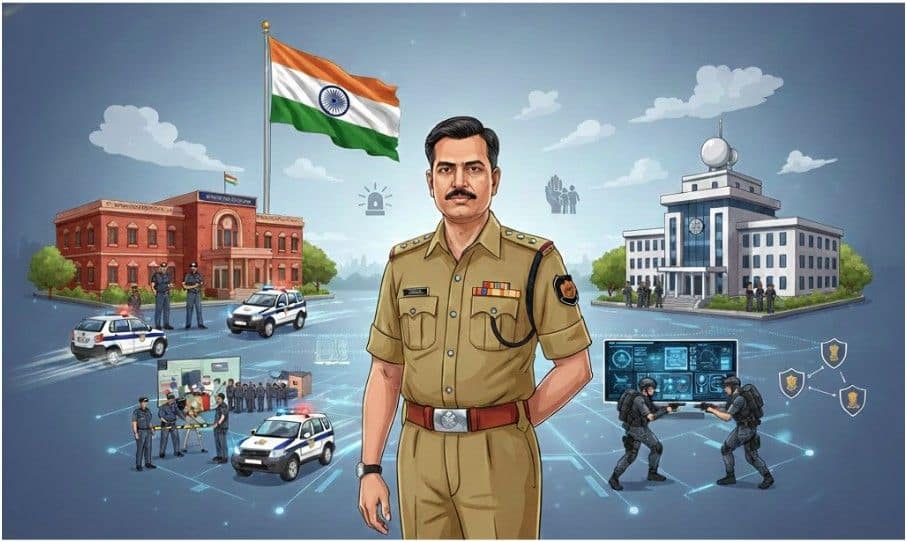
These operational powers give IPS officers immediate authority to act during crises, riots, and security threats across the state.
IAS vs IPS Power – Nature Of Authority Comparison
The IAS and IPS are both important parts of India’s civil services, working as two main pillars of government functioning.
Their power comes from different constitutional mandates, one shapes administration, the other ensures enforcement on the ground.
Here’s a detailed comparison table that breaks down their powers, authority, and career paths:
| Aspect | IAS | IPS |
|---|---|---|
| Role | Administration, governance, policy implementation | Law enforcement, public order, internal security |
| Highest Post | Cabinet Secretary | Director General of Police (DGP) |
| District Authority | District Magistrate (overall coordination) | Superintendent of Police (police operations) |
| Reporting Hierarchy | Coordinates district administration, including law & order | Policing functions are coordinated with the district administration |
| Salary (7th CPC) | Pay Level 10–17, apex ₹2.25 lakh (fixed) | Pay Level 10–17, apex ₹2.25 lakh (fixed) |
| Career Growth | District → State → Central policy roles | District → State/National police leadership |
Administrative power vs operational power defines their core difference, IAS handles policy-making vs enforcement authority of IPS, with distinct decision-making scope in IAS and IPS, yet equal public accountability and responsibility.
IAS vs IPS Salary, Rank, And Career Growth
Both services belong to the All India Services (AIS), which means they follow a similar Pay Matrix under the 7th Pay Commission, but their career ceilings and rank structures differ significantly.
Let’s look at the detailed salary structure and rank progression for both services:
| Career Stage | IAS Rank | IPS Rank | Basic Pay (7th CPC) |
|---|---|---|---|
| Entry (Years 1-4) | SDM / Asst. Secretary | ASP / Asst. Commissioner | ₹56,100 (Level 10) |
| Senior (Years 5-8) | ADM / Deputy Secretary | Addl. SP / Addl. CP | ₹67,700 (Level 11) |
| JAG (Years 9-12) | DM / Jt. Secretary | SP / Deputy Commissioner | ₹78,800 (Level 12) |
| Selection (Year 13) | DM / Director | SSP / Selection Grade SP | ₹1,18,500 (Level 13) |
| Super Time (Year 16) | Div. Commissioner / Secy | DIG | ₹1,31,100 (Level 13A) |
| Above Super Time | Principal Secretary | IG | ₹1,44,200 (Level 14) |
| Apex Scale | Chief Secretary | DGP / Director IB | ₹2,25,000 (Level 17) |
| Cabinet Level | Cabinet Secretary | No Equivalent | ₹2,50,000 (Level 18) |
Source: The data comes from the Statutory Pay Rules(2016) issued by the Department of Personnel and Training(DoPT), based on the 7th Central Pay Commission(CPC) Pay Matrix.
Promotion in IAS moves from district jobs to state secretariat positions and eventually to central ministries where policy is made. This progression gives IAS officers exposure to different aspects of governance at each level.
IPS officers move from district SP roles to Range DIGs who supervise multiple districts, then to state-level IGs before reaching the DGP position.
IAS vs IPS Authority At District Level (DM vs SP)
The District Magistrate (IAS )’s role in law and order includes coordinating all departments and issuing administrative orders during crises. The Superintendent of Police (IPS) role in enforcement involves deploying forces, conducting investigations, and making arrests.

Coordination between IAS and IPS happens through regular meetings and joint decision-making during emergencies.
The administrative framework as per DoPT defines clear responsibilities, the DM oversees overall district administration while the SP handles operational policing independently.
Conclusion: IAS Has Wider Administrative Authority While IPS Has Direct Enforcement Power
The IAS and IPS represent different types of power in India’s governance system.
The IAS handles administration and reaches higher ranks like Cabinet Secretary, managing policies across all departments. The IPS controls enforcement and commands police forces during crises.
Neither is absolutely more powerful, it depends on the situation. A Cabinet Secretary shapes national policies affecting millions, while a DGP leads thousands of officers during emergencies.
Choose IAS if you want to design government systems and policies. Choose IPS if you prefer leading enforcement operations and maintaining law and order on the ground.
FAQs
The IAS has wider control over administration, managing all departments, including police, while the IPS has focused power over law enforcement.
The IAS has a higher rank in government, reaching Cabinet Secretary (Level 18), while the IPS stops at DGP (Level 17).
The Cabinet Secretary is the top post, advising the Prime Minister and managing all ministries at Level 18.
The IAS manages policy work across all sectors, coordinates district administration, and reaches the highest government rank in India’s system.
The District Magistrate (IAS) coordinates law and order, but the IPS keeps direct control over police operations within that system.
The All India Rank 1 holder changes each year; you can check the latest topper’s name on the official UPSC website after the results.