

Every year, around 180 IAS officers are selected through the UPSC Civil Services Examination, which is India’s biggest and toughest government job exam.
The UPSC exam opens doors to many services like IAS, IPS, IFS, IRS, and several other government positions. The total number of seats changes each year based on what the government needs, but IAS selection stays pretty much the same.
This article will explain the exact numbers, how seats are divided among different categories, the selection data, and what affects the number of IAS officers chosen each year.
How Many IAS Officers Are Selected Every Year in India?
Around 180 IAS officers join the service each year, keeping India’s government system running smoothly. The IAS is the backbone of governance, making sure policies work properly from small districts to the national level.
This fixed number of 180 comes from the Baswan Committee, formed in 2016. They decided quality training matters more than just increasing numbers.
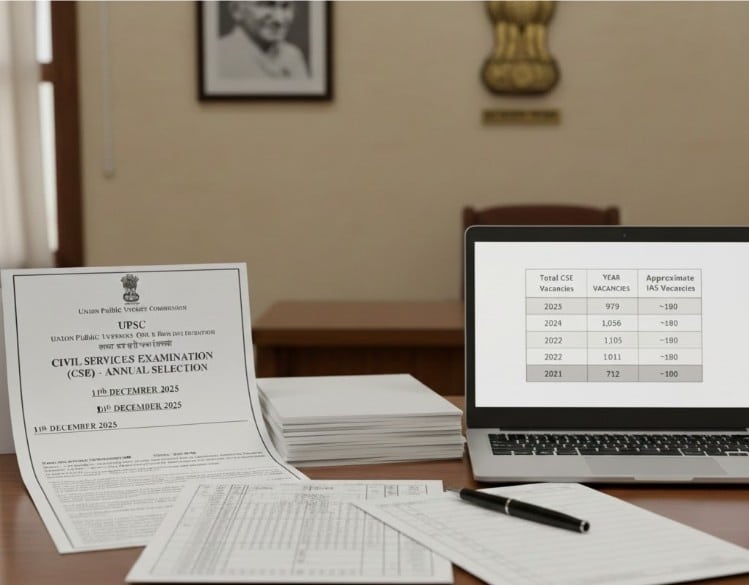
The UPSC exam gives out these IAS positions along with other important government jobs, creating a tough competition where people don’t just need to pass, they need to rank high enough to actually get IAS.
Total UPSC CSE Vacancies for 2025
According to the UPSC Official Notification dated January 22, 2025, the Civil Services Examination 2025 has 979 seats available for different services.
On top of this, 150 more seats were added for the Indian Forest Service. This brings the total to 1,129 positions across all services.
These numbers show how many fresh officers the government needs each year for multiple services, including IAS, IPS, IFS (Foreign Service), IRS (Income Tax and Customs), and other important government jobs.
IAS-Specific Allocation
Out of the 979 total seats, about 180 positions go to the IAS, following the fixed number recommended by experts.
The remaining seats are split among other services: roughly 200 positions for the Indian Police Service (IPS), while IFS, IRS, and other services get the remaining spots.
This setup makes sure each service gets enough new officers while keeping training quality high at their training schools.
Here is the Year-wise Total UPSC Vacancies (Recent Years):
| Year | Total CSE Vacancies | Approximate IAS Vacancies |
|---|---|---|
| 2025 | 979 | ~180 |
| 2024 | 1,056 | ~180 |
| 2023 | 1,105 | ~180 |
| 2022 | 1,011 | ~180 |
| 2021 | 712 | ~180 |
Even though total UPSC seats have moved up and down from 712 to 1,105 over the years, the IAS number stays steady at around 180 positions every year. This shows careful planning by the government rather than random changes.
UPSC CSE 2024 Selection Statistics
The UPSC 2024 exam showed just how tough this competition really is. Out of 9,92,599 people who registered, 5,83,213 actually appeared for the first round (Prelims).
Only 14,627 cleared it and moved to the Main Examination, just 2.5% of those who wrote the exam. The Interview round narrowed the pool to 2,845 candidates.
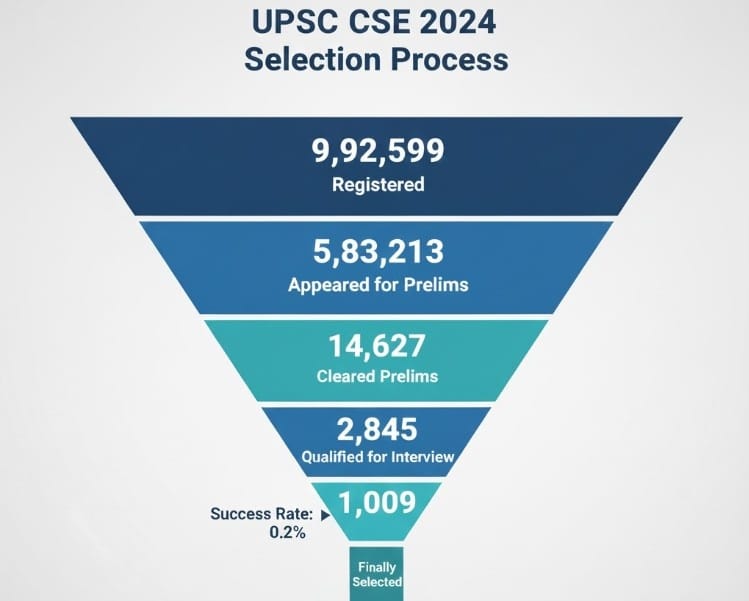
In the end, only 1,009 candidates made it to the final list announced by the Press Information Bureau(PIB) on April 22, 2025.
This means less than 0.2% succeed, making it one of the world’s hardest exams, where roughly 1,000 people compete for every single seat.
Category-wise Seat Distribution
UPSC follows the rules set by the Indian Constitution for giving seats to different groups.
The UPSC reservation policy requires specific percentages: 15% for Scheduled Castes (SC), 7.5% for Scheduled Tribes (ST), 27% for OtherBackward Classes (OBC) who don’t fall in the creamy layer, and 10% for Economically Weaker Sections (EWS).
The remaining seats go to General category candidates. For 2025, 38 positions were set aside for Persons with Benchmark Disability (PwBD) across different disability types.
The exact breakdown of IAS seats by category comes out only after final results are announced by the Department of Personnel and Training (DoPT).
UPSC CSE 2025 PwBD Category Distribution
| PwBD Category | Vacancies |
|---|---|
| Blindness/Low Vision (PwBD-1) | 12 |
| Deaf/Hard of Hearing (PwBD-2) | 7 |
| Locomotor Disability (PwBD-3) | 10 |
| Multiple Disabilities (PwBD-5) | 9 |
| Total PwBD | 38 |
Source: UPSC Official Notification 2025, January 22, 2025
This organized approach to including people with disabilities makes sure everyone gets fair representation while still keeping the exam based on merit.
Each person competes within their own category for available positions across all services.
IAS-Specific Allocation Pattern
The IAS works under a dual accountability structure, meaning IAS officers serve both state governments and the central government.
About 180 IAS positions are given out each year as part of the total UPSC seats, but UPSC doesn’t publish separate numbers for each service (IAS, IPS, IFS) when they first announce vacancies.

The exact IAS numbers come out only after final results when the Department of Personnel and Training shares the service-wise list.
Note: UPSC does not publish service-wise vacancy breakdown in initial notifications. The approximate 180 figure for IAS is based on historical allocation patterns.
Factors Affecting IAS Vacancies
The number of IAS officers needed each year is decided by government departments based on several things.
Retirement rates across different states, changing needs in administration at district and state levels, and the training capacity at LBSNAA (Lal Bahadur Shastri National Academy of Administration) in Mussoorie all play a role.
The government prefers quality over quantity, making sure each officer gets proper training before taking up big responsibilities. This careful approach prevents lowering service standards while still meeting what the country needs.
Suggested Reads:
Conclusion: Around 180 IAS Officers Are Selected Every Year
UPSC Civil Services Examination seats change every year based on government needs. For 2025, there are 979 positions. However, the IAS allocation stays steady at around 180 officers annually, showing careful government planning.
The exam is extremely competitive, with a less than 0.2% success rate, only 1,009 people selected from 9,92,599 applicants in 2024.
Aspiring candidates must understand that securing IAS requires not just clearing the exam but ranking in the top 180-200. This demands strong preparation, consistency, and smart planning for success.
FAQs
An IAS officer starts with a basic pay of ₹56,100 per month at the entry level (Junior Time Scale). This goes up to about ₹2,50,000 per month for the highest position (Cabinet Secretary). Plus, officers get extra money through allowances like DA, HRA, and TA, which makes the total pay much higher.
The last rank for IAS typically falls between Rank 150-200, varying by category, with General candidates usually needing ranks within 100-150.
If you get a rank around 1000 in UPSC, you’ll typically be placed in Group B services like Central Secretariat Service, AFHQ, or state services. IAS, IPS, IFS, and most Group A services go to people who rank in the top 500-600.
India currently has around 5,000 IAS officers working across different states, Union Territories, and central government positions.
UPSC selects around 900-1,100 candidates each year across all Civil Services (IAS, IPS, IFS, IRS, and others). The exact number changes based on how many seats the government announces. For example, 1,009 candidates were selected in 2024.